How to Manage Employee Leave and Absence for a Small Business
Managing employee leave in a UK small business means handling holiday entitlement, statutory sick pay, maternity and paternity leave, shared parental leave, and several newer entitlements including neonatal care leave — all while staying legally compliant. April 2026 brings major changes: SSP is payable from day one of sickness with no earnings threshold, paternity leave becomes a day-one employment right, and all statutory family pay rates increase to £194.32 per week. Getting any of this wrong exposes your business to tribunal claims, HMRC penalties, and payroll errors. This guide covers every type of leave a UK small business needs to understand in 2026, the exact statutory rates, the most common mistakes, and the software tools that make absence management reliable. If you employ anyone, these are the rules you cannot afford to get wrong.
How to Manage Employee Leave and Absence for a Small Business
Managing employee leave is one of those responsibilities that feels simple until it goes wrong. A missed holiday request, a misunderstood maternity policy, or an incorrectly calculated sick pay entitlement can quickly turn into a legal problem, a payroll mistake, or a workplace dispute that costs far more time and money than it should.
For small businesses in the UK, the challenge is sharper than it is for larger companies. There is no dedicated HR department to check the rules. The owner or manager is often the person approving leave, calculating entitlements, handling return-to-work conversations, and making sure everything feeds correctly into payroll — all while running the actual business.
The legal framework is not optional. UK employment law gives workers clear statutory rights to paid holiday, sick pay, maternity leave, paternity leave, shared parental leave, and several newer entitlements including neonatal care leave and bereaved partner's paternity leave. Getting any of these wrong exposes your business to employment tribunal claims, HMRC penalties, and reputational damage that is hard to undo.
This guide explains every type of leave and absence a UK small business needs to understand in 2026, including the major changes taking effect from April 2026. It covers the legal minimums, the rates you need to pay, the most common mistakes, and the tools that make the whole process manageable without a full HR team.
April 2026 brings significant changes to UK employee leave law. Statutory Sick Pay is being reformed, paternity leave becomes a day-one right, and parental leave no longer requires 12 months of service. If you employ anyone, you need to understand these changes before they take effect.
Annual leave and holiday entitlement
The foundation of UK leave management is the statutory annual leave entitlement. Under the Working Time Regulations 1998, nearly all workers in the UK are entitled to 5.6 weeks of paid annual leave per year. For a full-time employee working five days a week, that equals 28 days. Part-time workers receive the same entitlement on a pro-rata basis.
That 28-day statutory minimum can include or exclude bank holidays — that decision is entirely up to the employer. In England and Wales there are normally 8 bank holidays per year. Some employers include those within the 28 days, meaning the employee gets 20 discretionary days plus 8 bank holidays. Other employers offer the 28 days on top of bank holidays, giving 36 total. Either approach is legal, but it must be clearly stated in the employment contract.
| Working pattern | Statutory annual leave | Example |
|---|---|---|
| Full-time (5 days/week) | 5.6 weeks = 28 days | 20 discretionary days + 8 bank holidays, or 28 days including bank holidays |
| Part-time (3 days/week) | 5.6 weeks = 16.8 days | Pro-rata calculation: 3 ÷ 5 × 28 = 16.8 days |
| Part-time (2 days/week) | 5.6 weeks = 11.2 days | Pro-rata calculation: 2 ÷ 5 × 28 = 11.2 days |
| Irregular hours / zero-hours | 12.07% of hours worked | Can be accrued per pay period or paid as rolled-up holiday pay (12.07% uplift on each payslip) |
One important change that is now in effect is the legal recognition of rolled-up holiday pay for irregular-hours and part-year workers. Employers can now legally pay these workers an uplift of 12.07% on top of their normal wages as holiday pay, rather than requiring them to book and take separate paid leave days. If you use this method, the holiday pay must appear as a separate, clearly identified line item on the payslip.
Common holiday mistakes
- Not stating whether bank holidays are included — this is the single most common source of disputes about annual leave.
- Not pro-rating correctly for part-time staff — part-time workers must receive the same proportional entitlement as full-time workers.
- Preventing carry-over when it should be allowed — if an employee is unable to take leave due to sickness or maternity leave, they may have a legal right to carry untaken leave into the next year.
- No clear policy on requesting and approving leave — without a written process, disagreements become harder to resolve fairly.
Statutory Sick Pay: the April 2026 changes
Statutory Sick Pay is changing significantly from 6 April 2026. These are the biggest SSP reforms in years, and every UK employer needs to understand them before they take effect.
| SSP rule | Before April 2026 | From 6 April 2026 |
|---|---|---|
| When SSP starts | Day 4 of sickness (after 3 waiting days) | Day 1 of sickness |
| Earnings threshold | Must earn at least £125 per week | No minimum earnings requirement |
| Weekly SSP rate | £118.75 per week (flat rate) | £123.25 per week or 80% of average weekly earnings, whichever is lower |
| Who qualifies | Only employees above the earnings threshold | All employees regardless of earnings |
| Maximum duration | Up to 28 weeks | Up to 28 weeks (unchanged) |
The removal of the three waiting days is the change that will affect the most businesses operationally. Previously, if an employee was off sick for four days, you only paid SSP for one day. From April 2026, you pay SSP from day one. HMRC estimates that 1.3 million additional workers will become eligible for SSP because the earnings threshold is being removed.
The new calculation method also matters. Previously, SSP was always the flat rate. From April 2026, it is the lower of the flat rate (£123.25) or 80% of the employee's average weekly earnings. This means lower-paid workers will receive a proportionate amount rather than the full flat rate, which could be higher than their normal wages.
Transitional rule: Employees who were already off sick before 6 April 2026 and receiving SSP under the old rules will continue to receive the uprated flat rate of £123.25 for the remainder of their absence. The new day-one and 80% calculation rules apply to sickness absences starting on or after 6 April 2026.
What small businesses should do
- Update your payroll software to handle the new SSP calculation method and the removal of waiting days.
- Review your sickness absence policy to make sure it reflects the new rules and is communicated to employees.
- Budget for increased SSP costs — paying from day one instead of day four will increase the total cost of short-term sickness absence.
- Check your occupational sick pay scheme — if you offer enhanced sick pay above SSP, make sure the interaction between the two is clear in your policy.
Maternity leave and pay
Statutory Maternity Leave in the UK lasts up to 52 weeks. It is split into two parts: Ordinary Maternity Leave (the first 26 weeks) and Additional Maternity Leave (the remaining 26 weeks). The employee does not have to take all 52 weeks, but they must take a minimum of 2 weeks after the birth (4 weeks if they work in a factory).
Statutory Maternity Pay (SMP) is paid for up to 39 of those 52 weeks. The remaining 13 weeks are unpaid unless the employer offers an enhanced maternity pay scheme.
| SMP period | Rate from April 2026 |
|---|---|
| First 6 weeks | 90% of average weekly earnings (no cap) |
| Remaining 33 weeks | £194.32 per week or 90% of average weekly earnings, whichever is lower |
| Final 13 weeks | Unpaid (unless enhanced by employer) |
To qualify for SMP, the employee must have been continuously employed for at least 26 weeks into the 15th week before the expected week of childbirth, and they must earn at least £129 per week on average (the new lower earnings limit from April 2026, up from £125). They must also give proper notice — at least 15 weeks before the due date.
Small employers can recover most of the SMP they pay. If your total Class 1 National Insurance liability in the previous tax year was £45,000 or less, you can recover 103% of SMP from HMRC (100% plus 3% compensation). If it was above £45,000, you can recover 92%.
Paternity leave and pay: April 2026 changes
Paternity leave in the UK gives eligible fathers and partners the right to take either one or two weeks of leave following the birth or adoption of a child. The weeks can be taken consecutively or as two separate one-week blocks, and must be taken within 52 weeks of the birth or placement.
From 6 April 2026, paternity leave becomes a day-one employment right. Previously, employees needed at least 26 weeks of continuous service to qualify. That qualifying period is being removed under the Employment Rights Act 2025, meaning an employee can give notice to take paternity leave from the very first day of their employment.
| Paternity leave rule | Before April 2026 | From 6 April 2026 |
|---|---|---|
| Service requirement for leave | 26 weeks continuous service | Day-one right — no service requirement |
| Service requirement for pay | 26 weeks continuous service | 26 weeks (unchanged for pay) |
| Leave duration | 1 or 2 weeks | 1 or 2 weeks (unchanged) |
| Statutory Paternity Pay rate | £187.18 per week | £194.32 per week or 90% of AWE, whichever is lower |
| Taking leave after Shared Parental Leave | Not allowed | Now allowed |
There is an important distinction between the right to leave and the right to pay. While paternity leave itself becomes a day-one right, Statutory Paternity Pay still requires 26 weeks of continuous service and earnings above the lower earnings limit of £129 per week. This means a new employee can take time off from their first week but may not receive statutory pay for it unless they meet the pay eligibility criteria.
New from April 2026: Bereaved partner's paternity leave is also being introduced. Fathers and partners who lose their partner before the child's first birthday will be able to access up to 52 weeks of leave — a significant new entitlement designed to support bereaved parents.
Shared Parental Leave
Shared Parental Leave (ShPL) allows eligible parents to share up to 50 weeks of leave and up to 37 weeks of Statutory Shared Parental Pay (ShPP) between them. The mother or primary adopter must curtail their maternity or adoption leave early to create the shared leave entitlement.
From April 2026, the weekly rate of Statutory Shared Parental Pay increases to £194.32 or 90% of average weekly earnings, whichever is lower. The qualifying requirements remain: both parents must have been employed for at least 26 weeks by the end of the 15th week before the expected week of childbirth, and the parent taking leave must earn at least £129 per week.
ShPL can be taken in blocks rather than all at once, which gives parents more flexibility than traditional maternity or paternity leave. However, the administrative complexity of ShPL means it remains underused. Small businesses should make sure their employment contracts and policies explain the option clearly, even if uptake is low.
Unpaid Parental Leave: now a day-one right
Unpaid Parental Leave gives employees the right to take up to 18 weeks of unpaid leave per child, up to the child's 18th birthday. The leave must be taken in blocks of one week (unless the child is disabled), with a maximum of four weeks per child per year.
From 6 April 2026, unpaid parental leave becomes a day-one employment right. Previously, employees needed at least one year of continuous service to qualify. The removal of this qualifying period means that any new employee with a child under 18 can request unpaid parental leave from their first day.
This change is important for small businesses to understand because it increases the likelihood of leave requests from newer employees. While the leave is unpaid, the operational impact of an employee being absent for up to four weeks per year still needs to be planned for.
Neonatal Care Leave
Neonatal Care Leave came into force on 6 April 2025 and applies to parents of babies born on or after that date who are admitted into neonatal care within 28 days of birth and have a continuous stay in hospital of at least 7 full days.
Eligible parents can take up to 12 weeks of Neonatal Care Leave on top of any other statutory leave they are entitled to, including maternity and paternity leave. This is a day-one right — no qualifying period of service is needed for the leave itself.
| Neonatal Care Leave detail | What it means |
|---|---|
| Eligibility | Day-one right for all employees whose baby qualifies |
| Maximum leave | Up to 12 weeks (1 week accrues for each 7 consecutive days of neonatal care) |
| Statutory Neonatal Care Pay (from April 2026) | £194.32 per week or 90% of AWE, whichever is lower |
| Pay eligibility | 26 weeks continuous service and earnings above the lower earnings limit (£129/week) |
| Must be taken within | 68 weeks of the child's birth |
| Multiple births | Entitlement does not increase for multiple births |
All statutory pay rates from April 2026
Here is a single reference table for every statutory payment rate that applies from 6 April 2026. These are the rates small businesses need in their payroll systems.
| Statutory payment | Rate from April 2026 |
|---|---|
| Statutory Sick Pay (SSP) | £123.25/week or 80% of AWE, whichever is lower |
| Statutory Maternity Pay — first 6 weeks | 90% of AWE (no cap) |
| Statutory Maternity Pay — remaining 33 weeks | £194.32/week or 90% of AWE, whichever is lower |
| Statutory Paternity Pay | £194.32/week or 90% of AWE, whichever is lower |
| Statutory Shared Parental Pay | £194.32/week or 90% of AWE, whichever is lower |
| Statutory Adoption Pay — first 6 weeks | 90% of AWE (no cap) |
| Statutory Adoption Pay — remaining 33 weeks | £194.32/week or 90% of AWE, whichever is lower |
| Statutory Parental Bereavement Pay | £194.32/week or 90% of AWE, whichever is lower |
| Statutory Neonatal Care Pay | £194.32/week or 90% of AWE, whichever is lower |
| Lower Earnings Limit (for pay eligibility) | £129/week |
The biggest absence management mistakes small businesses make
Understanding the rules is one thing. Applying them consistently without errors is another. These are the mistakes that trip up small businesses most often.
No written absence policy
Without a clear policy, employees do not know how to report absence, managers do not know how to handle it, and disputes are harder to resolve. Every small business should have a written absence policy covering notification requirements, evidence needed (such as fit notes), and return-to-work procedures.
Treating all absence the same
Short-term sickness, long-term illness, disability-related absence, and pregnancy-related absence all have different legal treatments. Disciplining an employee for disability-related absence without considering reasonable adjustments, for example, creates serious discrimination risk.
Not tracking absence properly
If you do not record who is absent, when, why, and for how long, you cannot spot patterns, calculate entitlements accurately, or manage persistent absence fairly. Spreadsheets break down quickly once you have more than a handful of employees.
Ignoring return-to-work conversations
A brief return-to-work conversation after every absence is one of the most effective ways to reduce future absence. It shows you noticed, it gives the employee a chance to raise concerns, and it signals that absence is managed rather than ignored.
Miscalculating holiday for leavers
When an employee leaves, they are entitled to pay for any accrued but untaken holiday. Getting this wrong — especially mid-year — leads to underpayment claims. Use a pro-rata calculation based on the proportion of the leave year worked.
Not updating for April 2026 changes
The SSP reforms, day-one paternity leave, and day-one parental leave all take effect in April 2026. Businesses that do not update their policies, contracts, and payroll software before then will be non-compliant from day one.
How absence tracking tools help
Once a small business has more than five or six employees, managing leave and absence manually becomes unreliable. Requests get lost, entitlements are miscalculated, team availability is unclear, and the administrative overhead grows quickly.
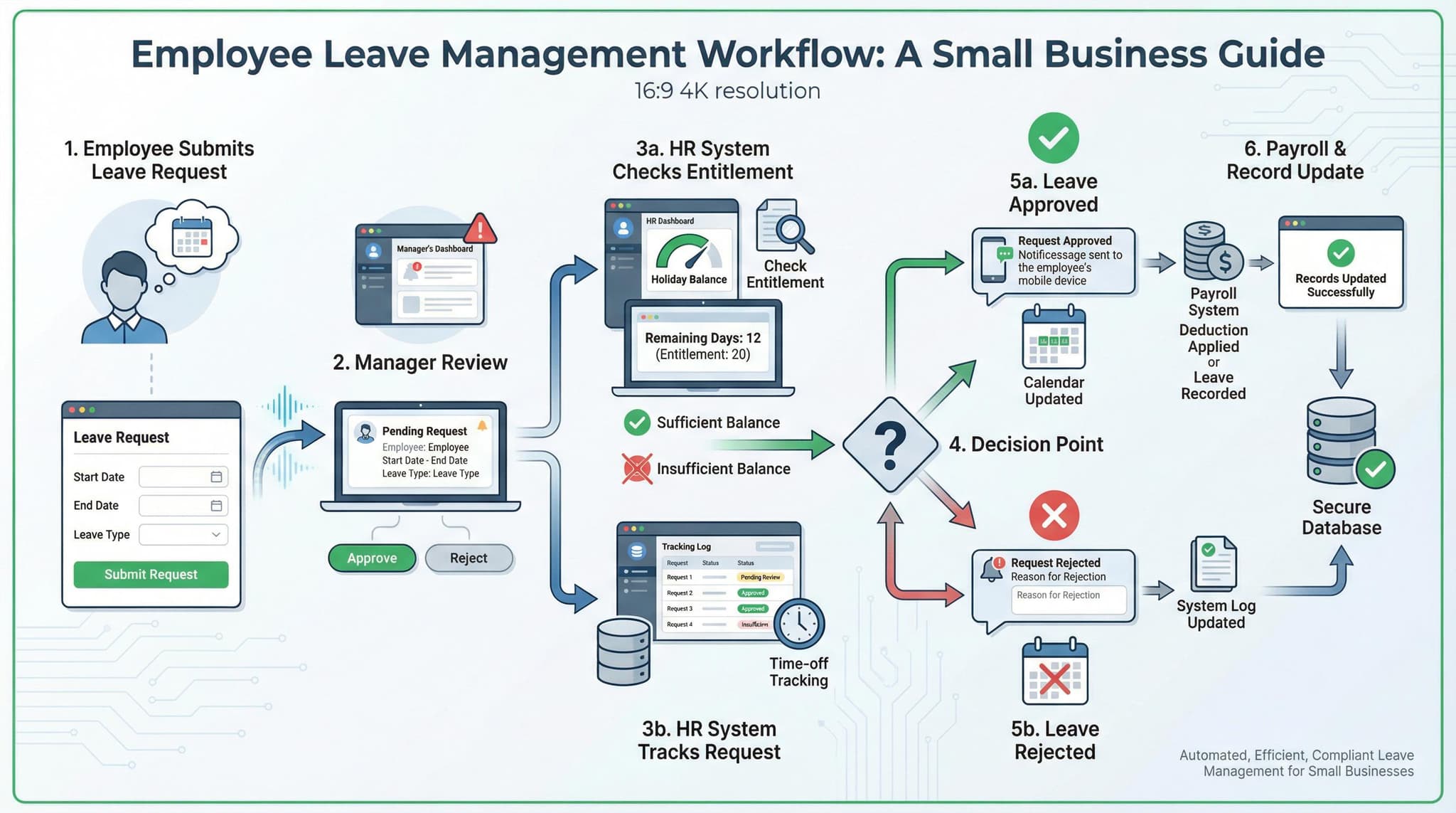
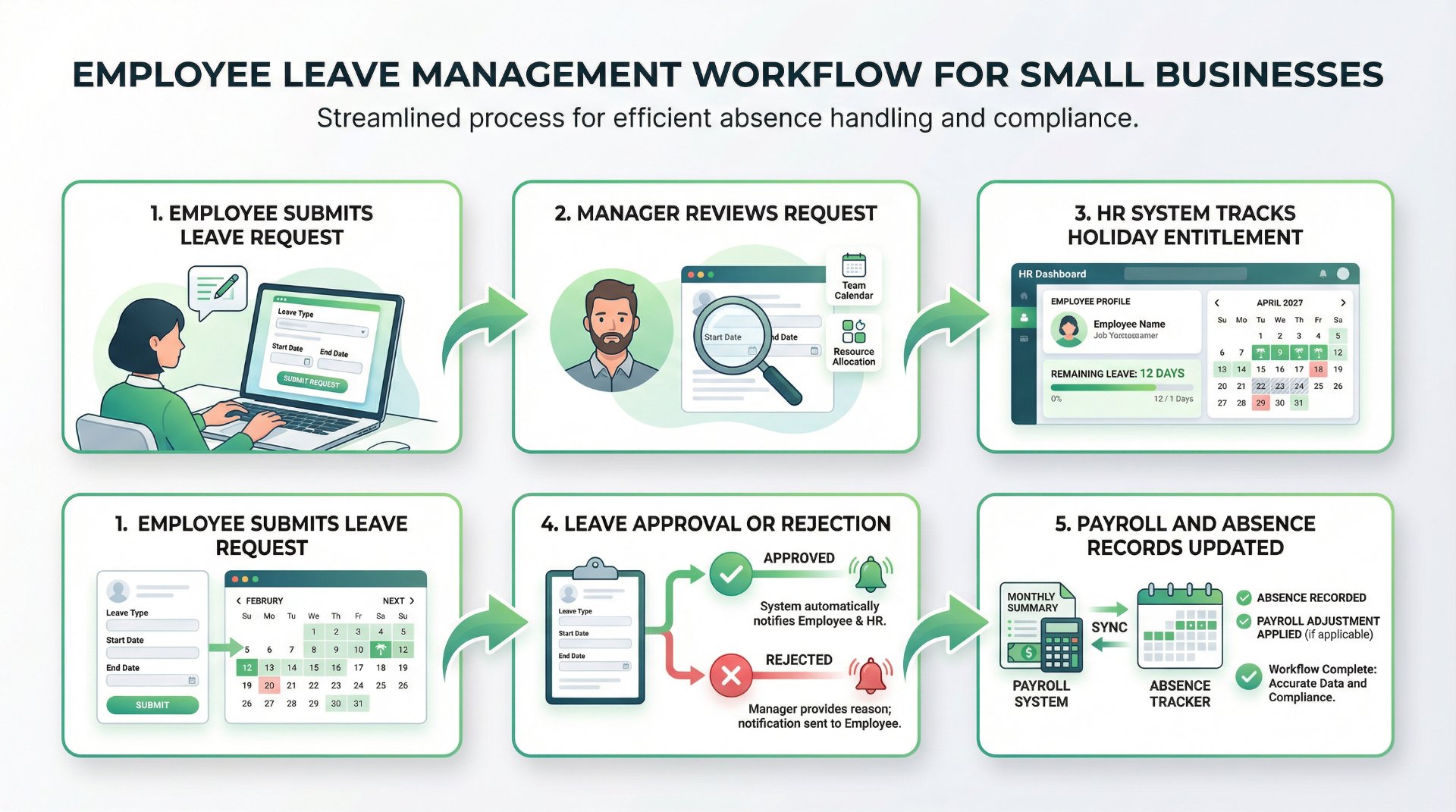
Leave and absence management software solves these problems by centralising everything in one place. Employees request leave through the system, managers approve or decline with full visibility of team availability, and the software calculates entitlements, tracks balances, and records all sickness absence automatically.
What to look for
- Team calendar — a shared view showing who is absent, on leave, or working from home on any given day, so managers can avoid approving leave that would leave the team short.
- Automatic entitlement calculation — the software should calculate annual leave for full-time, part-time, and irregular-hours workers correctly, including pro-rata calculations and accrual tracking.
- Sickness tracking with Bradford Factor — the Bradford Factor scores frequent short absences higher than single long absences, helping managers spot concerning patterns early.
- Return-to-work workflow — automated prompts for managers to complete a return-to-work conversation and record any notes or actions.
- Payroll integration — absence data should flow into your payroll system so SSP, holiday pay, and statutory family leave payments are calculated correctly without manual re-entry.
- Mobile access — employees and managers should be able to request, approve, and view leave from a phone, not just a desktop.
- Reporting — absence reports by team, individual, reason, and time period help identify trends and support fair management decisions.
Tools worth considering
| Tool | Best for | Key strength |
|---|---|---|
| Sage HR | Small businesses already using Sage Accounting or Sage Payroll | Integrates leave and absence management with payroll and accounting in one connected ecosystem. Mobile app for requests and approvals. |
| BrightHR | UK SMEs wanting a dedicated absence management platform | Built-in Bradford Factor scoring, automated return-to-work workflows, and strong compliance features for UK employers. |
| Breathe HR | Small businesses wanting simplicity and quick setup | Visual team calendar, sickness tracking with reason categories, and TOIL management. Deliberately simple interface. |
| Leave Dates | Very small teams needing lightweight leave tracking | Clean calendar-based interface, mobile app, and low per-user pricing for small teams. |
For small businesses that already use Sage for accounting or payroll, Sage HR is the most natural fit because leave and absence data connects directly into the payroll workflow. That means SSP calculations, holiday pay adjustments, and statutory family leave payments are handled in one joined-up system rather than being managed across separate tools with manual data transfers.
Building an absence policy that works
Every small business should have a written absence policy. It does not need to be long. It needs to be clear, consistent, and communicated to every employee.
What your policy should cover
- Notification rules: who to contact, by when, and how (phone, app, email) when an employee is absent.
- Evidence requirements: when a self-certification form is sufficient (usually the first 7 calendar days of sickness) and when a fit note from a GP is required (usually from day 8 onward).
- SSP entitlement: explain the statutory sick pay rules, including the April 2026 changes, and any enhanced sick pay the business offers.
- Return-to-work process: confirm that a brief return-to-work meeting will happen after every absence, and explain what it involves.
- Trigger points: explain the thresholds (number of absences, total days, or Bradford Factor scores) that will lead to a formal absence review meeting.
- Annual leave booking: how to request leave, how far in advance, who approves it, and any blackout periods.
- Carry-over rules: how much unused leave can be carried into the next year and under what circumstances.
- Family leave: a summary of maternity, paternity, shared parental, adoption, neonatal care, and parental bereavement leave entitlements, with a note that full details are available on request.
- Unpaid leave: explain under what circumstances unpaid leave may be granted and who approves it.
- Disability-related absence: confirm that disability-related absence will be considered separately and that reasonable adjustments will be discussed.
Key dates for April 2026
If you employ anyone in the UK, these are the leave-related changes you need to have implemented before or on 6 April 2026.
| Change | Effective date | Action required |
|---|---|---|
| SSP from day 1 of sickness | 6 April 2026 | Update payroll software and sickness absence policy |
| SSP earnings threshold removed | 6 April 2026 | Ensure all employees are included in SSP eligibility regardless of earnings |
| SSP rate: £123.25 or 80% of AWE | 6 April 2026 | Update payroll software to use the new dual-rate calculation |
| Paternity leave: day-one right | 6 April 2026 | Update employment contracts, policies, and onboarding documents |
| Unpaid parental leave: day-one right | 6 April 2026 | Update parental leave policy and remove 1-year service requirement |
| Bereaved partner's paternity leave introduced | 6 April 2026 | Add to your leave policy and brief managers on the new entitlement |
| Paternity leave allowed after Shared Parental Leave | 6 April 2026 | Update shared parental leave and paternity leave policies |
| All statutory family pay rates increase to £194.32/week | 6 April 2026 | Confirm payroll software has updated to the new rates |
| Lower Earnings Limit increases to £129/week | 6 April 2026 | Confirm payroll software uses the new threshold for pay eligibility checks |
Your absence management checklist
Policies and contracts
- Written absence policy in place and communicated to all staff.
- Employment contracts clearly state holiday entitlement and whether bank holidays are included.
- Maternity, paternity, shared parental, and neonatal care leave policies are up to date.
- Policies reflect April 2026 changes to SSP, paternity leave, and parental leave.
Systems and tracking
- Leave and absence management software is in place (or planned).
- Team calendar shows real-time availability.
- Sickness absence is recorded with dates, reasons, and Bradford Factor scores.
- Absence data integrates with payroll for accurate SSP and statutory pay calculations.
Processes
- Return-to-work conversations happen after every sickness absence.
- Trigger points for formal absence reviews are defined and applied consistently.
- Managers know how to handle disability-related absence and reasonable adjustments.
- Holiday requests are approved through a defined process with adequate notice.
Payroll readiness
- Payroll software is updated for April 2026 SSP changes.
- All statutory pay rates are set to the new April 2026 figures.
- Lower Earnings Limit updated to £129/week.
- Paternity leave eligibility updated to reflect day-one rights.
Managing employee leave and absence well is not about being generous or strict. It is about being consistent, clear, and legally compliant. The businesses that do it well tend to have lower absence rates, fewer disputes, and better employee trust. The businesses that do it badly tend to discover the cost only when a tribunal claim or an HMRC investigation arrives.
The smartest move for any small business in 2026 is to put the right policy in place, use software to track everything properly, and make sure your payroll system is ready for the April changes before they take effect.