Sage HR Review: Is It Worth Adding to Your Sage Accounting Stack?
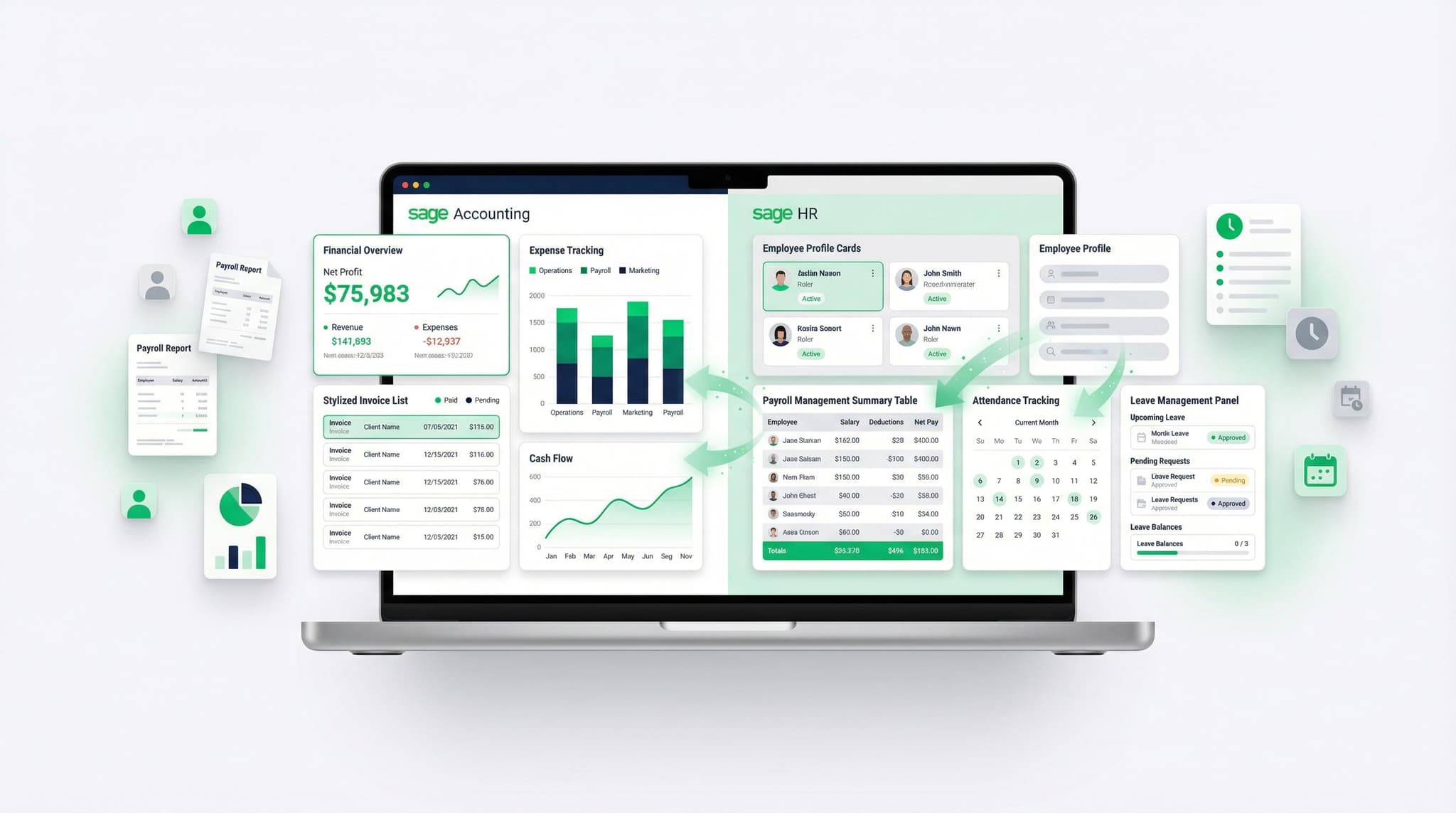
Sage HR is a solid option for UK SMEs that want to move beyond spreadsheets and manage leave, employee records, onboarding, and basic people admin in one place.What makes it stand out is the modular pricing, so you can start small and only add extras like performance, shifts, timesheets, or expenses when you actually need them. If you already use Sage Accounting or Sage Payroll, Sage HR makes even more sense because the whole people-and-finance setup feels much more connected. For most growing businesses, especially in the 25 to 100 employee range, it's a practical, professional HR tool that's easy to justify.
Sage HR Review: Is It Worth Adding to Your Sage Accounting Stack?
Here's a question I hear from a lot of UK small business owners: "I'm already using Sage for my accounting. Should I use Sage HR too, or should I look at something else for managing my people?"
It's a fair question. When you're already inside the Sage ecosystem — your invoices, your bank feeds, your VAT, your payroll, maybe even Sage Copilot running in the background — there's a natural pull toward keeping everything under one roof. But "it's made by the same company" isn't a good enough reason to buy software. It needs to actually be good.
So I spent a lot of time digging into Sage HR. What it does. What it doesn't do. How it's priced. How it fits into the broader Sage stack. Where it shines. Where it's frustrating. And most importantly, whether it's genuinely worth it for a UK small business that's growing and starting to feel the pain of managing people with spreadsheets, WhatsApp messages, and bits of paper stuck to a noticeboard.
This is an honest review. Not a product page rewrite. Let's get into it.
What is Sage HR, exactly?
Sage HR is a cloud-based human resources management platform designed for small and medium businesses with up to 250 employees. It was originally built as CakeHR — an independent HR startup — before Sage acquired it and brought it into the Sage Business Cloud family.
That origin story actually matters. Unlike some HR tools that started as add-ons to accounting software and never quite grew up, Sage HR was born as a purpose-built HR product. It was designed from the ground up for managing people, not bolted onto a finance system as an afterthought. Sage then layered its UK compliance expertise, payroll integration, and enterprise support infrastructure on top.
The result is a product that feels like a proper HR system but is sized and priced for small businesses. It's not trying to compete with Workday or SAP SuccessFactors. It's trying to help the office manager at a 30-person company stop using spreadsheets for holiday tracking and start running HR like a real function.
Who is it built for?
Sage says Sage HR is best suited to small and medium businesses, for work on site or on the go. In practical terms, the sweet spot is probably businesses with 10 to 250 employees — big enough that managing people informally has started to break down, but not so big that you need enterprise-grade HRIS with custom integrations and dedicated implementation teams.
If you have fewer than 25 employees, it's worth knowing that Sage includes basic HR features inside Sage Payroll. So you might not even need the standalone Sage HR product yet. Sage themselves say that for businesses with less than 25 employees, you can get HR features with Sage Payroll.
But once you're past that 25-person mark — or once you need performance management, shift scheduling, timesheets, recruitment tools, or expense management — the standalone Sage HR product starts making a lot of sense.
What does it actually do?
Sage HR uses a modular approach. You start with the core platform and then add the modules you need. That's one of the smartest things about the product, because it means a 15-person design agency doesn't have to pay for shift scheduling it will never use, and a 100-person hospitality business doesn't have to pay for recruitment tools if it handles hiring a different way.
Here's what each piece covers:
Core HR + Leave Management (the base)
This is the foundation that every Sage HR customer gets. It includes:
- Employee database with workforce profiles, organisational charts, and company directory
- Leave management — holiday requests, approvals, balances, shared calendars, and absence tracking
- Custom approval workflows so the right manager signs off the right request
- Document storage with customisable permissions
- Digital documents and e-signatures — no more printing, signing, and scanning
- Onboarding workflows for new starters
- Company announcements and internal communications
- Employee self-service via desktop and mobile app
- Detailed reporting across your people data
Honestly, the core platform alone solves the biggest pain point most small businesses have: knowing who's off, managing holiday requests without a spreadsheet nightmare, and having one central place where employee information lives. If that's all you need right now, it's worth the money.
The add-on modules
Performance
Set goals, schedule 1-to-1 meetings, run 360 feedback, create surveys, and manage quick feedback loops. This is for businesses that want structured performance management without buying a separate tool.
Shift Scheduling
Flexible shift planning with drag-and-drop scheduling, pre-defined shift templates, daily visual reports, location-based schedule groups, and mobile access for employees. One customer said it reduced creating fortnightly shift schedules from six hours to just two.
Timesheets
A fast, simple way for employees to track working hours and overtime. Useful for businesses that bill by the hour or need accurate records for compliance and payroll purposes.
Expenses
Submit and manage expenses from the mobile app. Employees photograph receipts, submit claims, and managers approve — all without paper forms or email chains.
Recruitment
Create job ads, build application forms, manage the applicant pipeline, schedule interviews, design a careers page, and build landing pages. This is a full-licence module rather than per-employee, so it's priced differently from the others. If you're hiring regularly, it can replace basic ATS tools.
How much does it cost?
This is one of the areas where Sage HR genuinely stands out. The modular pricing means you build your own plan based on what you actually need, and you only pay for the modules you use. No bloated bundles. No paying for features that sit unused.
| Module | UK Price | Billing |
|---|---|---|
| Core HR + Leave Management | From £4.60 per employee/month | Per employee, per month |
| Performance | £2.30 per employee/month | Per employee, per month |
| Shift Scheduling | £2.30 per employee/month | Per employee, per month |
| Timesheets | £2.30 per employee/month | Per employee, per month |
| Expenses | £1.15 per employee/month | Per employee, per month |
| Recruitment | £170 per month | Flat monthly fee |
Let's run some real numbers to make this concrete.
Example: 20-employee business
If you have 20 employees and you only need core HR with leave management, you're looking at about £92 per month. That's less than £5 per person. For a proper cloud HR system with a mobile app, self-service, reporting, e-signatures, and onboarding workflows, that's genuinely good value.
Now let's say you add performance management and timesheets. That's £4.60 + £2.30 + £2.30 = £9.20 per employee per month. For 20 employees, that's £184 per month. Still very reasonable for what you're getting.
And if you go all-in — core, performance, shifts, timesheets, expenses, and recruitment — you're looking at roughly £12.65 per employee plus £170 flat for recruitment. For 20 employees, that's about £423 per month. Not cheap, but competitive for a full HR platform.
Example: 50-employee business
Core only: about £230 per month. Core plus performance and shifts: about £460 per month. Full stack: roughly £802.50 per month. At that scale, you're still well under £20 per employee for the complete HR system, which compares favourably to most alternatives.
The mobile app — this matters more than you think
If there's one thing that separates modern HR software from old-school HR systems, it's the mobile experience. And Sage HR's mobile app is genuinely one of its strongest features.
Sage describes Sage HR as being designed for work on site or on the go, with an intuitive design that carries over to the mobile app. Employees, managers, and HR teams can submit and manage time off, expenses, feedback, payslips, and more from a desktop or mobile device.
In practical terms, that means:
- Employees can request holiday from their phone in about 30 seconds
- Managers can approve or decline from a notification without opening a laptop
- Staff can check their remaining leave balance without asking anyone
- Expense claims can be submitted by photographing a receipt on the spot
- Shift schedules can be viewed and updated in real time
- Feedback and check-ins can happen from anywhere
The app is available on both iOS (App Store) and Android (Google Play). Sage says it's designed for high performance even on low internet speeds — around 2Mb — and that a standard 3G connection should be sufficient. That's a thoughtful design choice for businesses where not everyone works at a desk with fast wifi.
For field-based teams, retail staff, hospitality workers, or anyone who isn't sitting at a computer all day, the mobile app changes the entire HR experience. It turns HR from something that happens at a desk into something that happens wherever work happens.
How it fits into the Sage ecosystem
This is really the core question of this review. Not just "is Sage HR good?" but "is Sage HR good enough to justify keeping everything in one ecosystem?"
The answer, for most UK SMEs, is yes. And here's why.
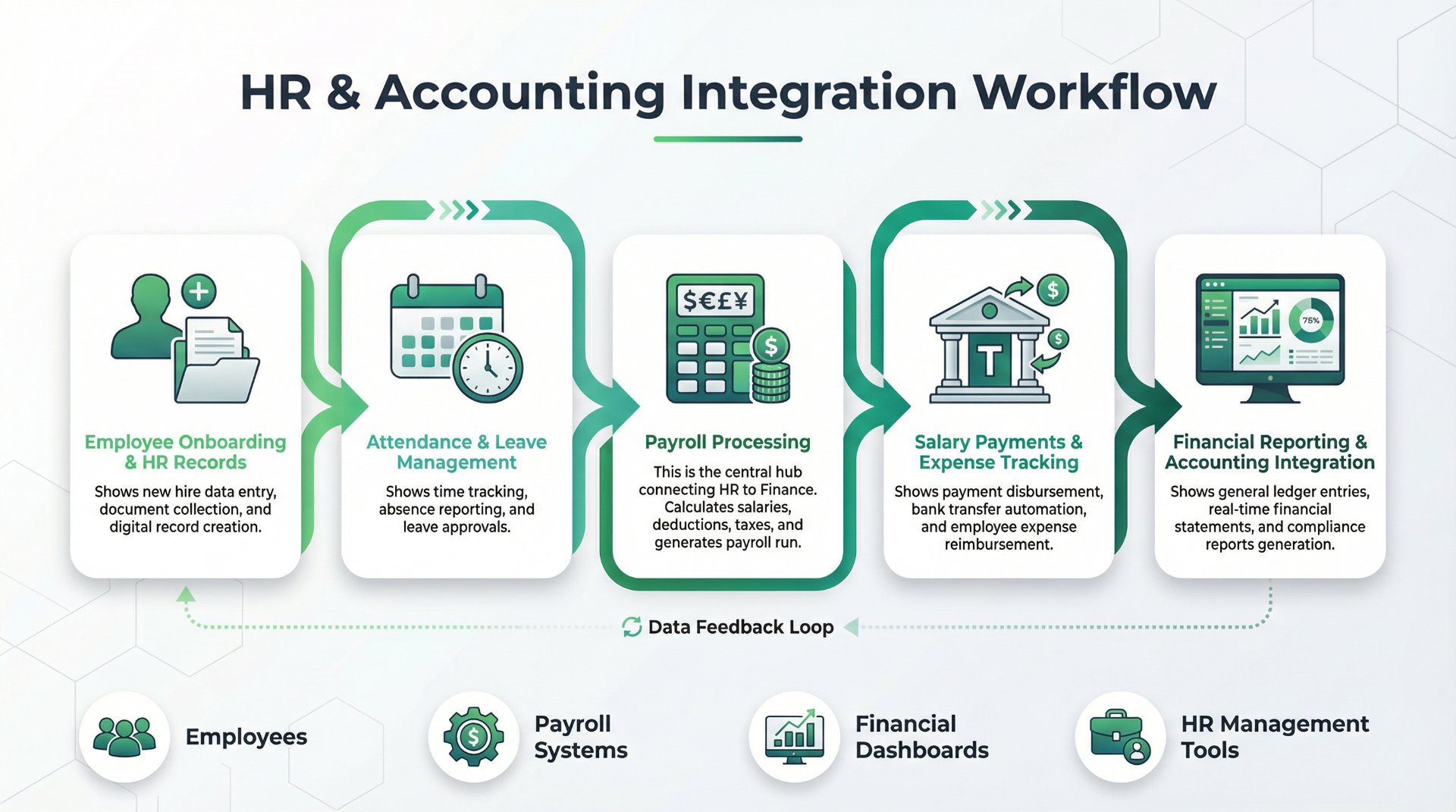
When you run Sage Accounting, Sage Payroll, and Sage HR together, you get a connected platform where money and people management talk to each other. Sage positions this as "one platform that empowers small businesses to manage their business money, people, and payroll all in one place." That's not just marketing language — it describes a real operational benefit.
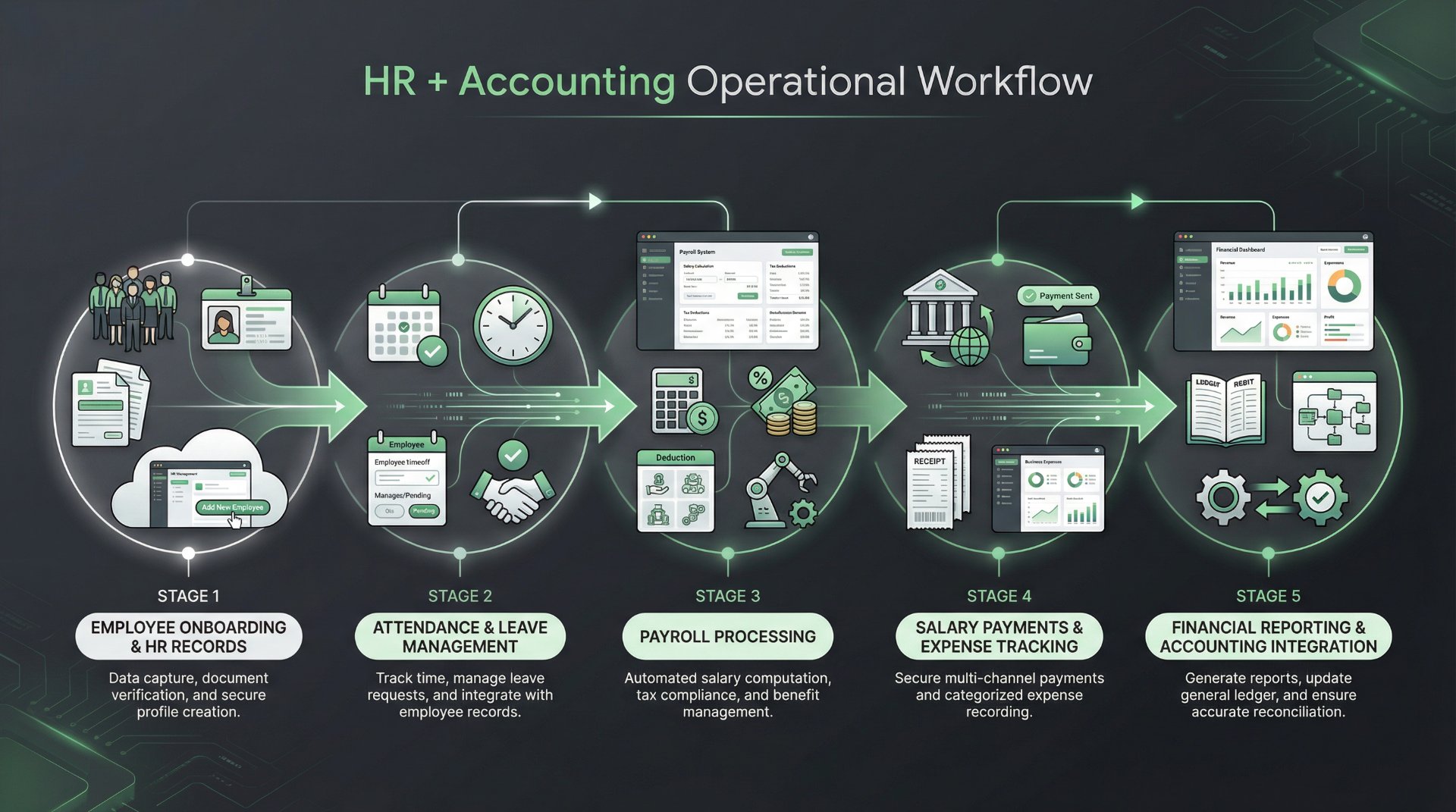
Think about what happens in a typical small business when these systems are separate. Payroll runs in one tool. HR data sits in another. Accounting lives somewhere else. When someone joins, their details get entered three times. When someone leaves, their data gets updated in three places — if you're lucky. When a manager approves overtime, it may or may not reach payroll accurately. When expenses are approved in HR, they may or may not reach the accounting system cleanly.
When everything sits in Sage, those hand-offs become much smoother. Employee data flows between HR and payroll. Approved expenses can reach the accounts. Leave records align with payroll calculations. The single-source-of-truth problem — which plagues every growing business — becomes much more manageable.
The Sage stack for UK SMEs
- Sage Accounting — invoicing, expenses, bank reconciliation, VAT, reporting, Sage Copilot
- Sage Payroll — pay runs, RTI submissions, auto-enrolment pensions, payslips (includes basic HR for under 25 employees)
- Sage HR — leave management, performance, shifts, timesheets, expenses, recruitment, employee self-service
Together, these three products cover the core finance and people workflows that every growing UK business needs. And because they're all built by Sage and designed to work together, the integration is native rather than bolted on.
The 30% claim — can it really cut admin time that much?
Sage says businesses can "reduce people admin time by 30%" with Sage HR. That's a big claim, and I'm always cautious about headline efficiency numbers. But when I think about what small businesses are actually doing before they implement HR software, 30% doesn't sound unreasonable.
Consider a typical 40-person company without HR software. Holiday requests come in by email. The office manager updates a spreadsheet. Approvals happen verbally or via WhatsApp. Nobody's quite sure how many days Sarah has left. The sick absence record lives in someone's email archive. Shift changes get written on a whiteboard. Expenses come in as paper receipts stuffed in envelopes. Performance reviews happen once a year — maybe — using Word documents saved to a shared drive.
Now put all of that into a centralised cloud system with automated workflows, self-service access, and mobile capability. The time savings across leave management alone can be significant. Add in digital expenses, automated approvals, and structured performance processes, and 30% starts to feel conservative rather than optimistic.
The bigger benefit, honestly, isn't just time saved. It's stress reduced. When HR processes work properly, managers spend less energy chasing admin and more energy managing people. That's the real productivity gain — and it's much harder to quantify but much more valuable in practice.
What I like about Sage HR
- Modular pricing is genuinely fair. You pay for what you use. Period. No bundle bloat, no feature gates that force you into expensive plans, no annual lock-in.
- The mobile app is excellent. It works smoothly, it's intuitive, and it makes self-service feel natural rather than clunky.
- Leave management is the best in class at this price point. Shared calendars, custom approval flows, balance tracking, and team visibility are all handled cleanly.
- The 30-day free trial with no payment details required is a confident move. It tells you Sage believes the product can sell itself.
- Ecosystem integration with Sage Accounting and Sage Payroll creates a genuine operational advantage for businesses already in the Sage world.
- UK compliance awareness. The platform is tailored for UK employment practices, HMRC requirements, and GDPR security measures.
- Shift scheduling is powerful but simple. The drag-and-drop interface and self-service availability preferences solve a real problem for shift-based businesses.
- E-signatures and digital documents eliminate paper-based HR admin without needing a separate document tool.
What I'd like to see improved
- Reporting could be deeper. The core reporting is solid, but power users and HR leads at larger SMEs may find themselves wanting more customisation, more export flexibility, and more visual dashboards.
- Customer support is email and chat during UK business hours. That's fine for most situations, but if you're used to Sage Accounting's telephone support, you might notice the difference.
- The performance module is good but basic. It covers goals, 1-to-1s, 360 feedback, and surveys. For companies that want deep competency frameworks or OKR-specific tooling, it may feel light compared to dedicated performance platforms.
- Integration depth with third-party tools could be broader. If you use non-Sage tools for project management, CRM, or other workflows, check whether the integration you need exists before committing.
- Module costs can add up. If you need four or five modules for a larger team, the total can grow past what some businesses expect from "modular" pricing. It's still competitive, but run the numbers for your specific scenario.
How it compares to alternatives
Sage HR isn't the only HR platform for UK small businesses. Let's put it in context.
| Platform | Best for | Starting price | Key strength | Key limitation |
|---|---|---|---|---|
| Sage HR | UK SMEs already on Sage, 10–250 employees | £4.60/employee/month | Modular pricing, Sage ecosystem, mobile app | Reporting depth, support channels |
| BreatheHR | UK micro businesses, 1–50 employees | From ~£13/month (flat) | Very simple, affordable for tiny teams | Limited scalability and module depth |
| Charlie HR | UK startups and small teams | From ~£5/employee/month | Modern UX, good onboarding flows | Less module breadth than Sage HR |
| HiBob | Mid-market and scale-ups, 100+ employees | Custom pricing | Deep analytics, modern design, culture tools | Overkill and expensive for smaller SMEs |
| Xero + Deel/Remote | Distributed or international teams on Xero | Varies | Global payroll and compliance | Complex setup, not a single integrated stack |
Sage HR's sweet spot is clear: UK-based SMEs that want a proper modular HR system, are already in the Sage ecosystem (or planning to be), and need something that scales from 10 to 250 employees without becoming enterprise-level complex or enterprise-level expensive.
The under-25 employee question
I want to address this specifically because it comes up a lot.
If your business has fewer than 25 employees, Sage says you can get HR features included with Sage Payroll. That means basic people management — employee records, payslips, and core HR administration — comes automatically when you buy payroll. You don't need the standalone Sage HR product.
That's a great deal for very small businesses. It means you can run accounting, payroll, and basic HR all within the Sage ecosystem for a combined cost that's hard to beat.
The question becomes: at what point do you upgrade to standalone Sage HR? My answer would be: when you start needing structured leave management with proper approval workflows, performance reviews, shift scheduling, or when your team grows past the point where basic HR features feel sufficient. For most businesses, that tipping point is somewhere between 20 and 30 employees — though some hit it earlier if their operational complexity demands it.
Is it worth adding to your Sage stack?
Let me give you the honest answer in three scenarios.
Under 25 employees
Probably not yet. Use the HR features built into Sage Payroll. They'll cover your basics. Save the standalone Sage HR investment for when your team grows or when you need modules like performance, shifts, or structured leave management.
25 to 100 employees
Yes, strongly recommended. This is Sage HR's absolute sweet spot. You're big enough that informal HR processes are breaking down, but not so big that you need enterprise tools. Sage HR gives you the structure, the self-service, and the automation to manage people properly without hiring a dedicated HR team.
100 to 250 employees
Yes, with caveats. Sage HR will serve you well for core HR, leave, shifts, and performance. But at this scale, check whether the reporting depth, integration breadth, and support model meet your needs. Some businesses at the upper end start evaluating mid-market platforms. But for many, Sage HR still does the job and does it more affordably.
The ecosystem argument
There's a broader strategic point here that's easy to overlook.
When you use Sage Accounting, Sage Payroll, and Sage HR together, you're not just buying three products. You're building an operating system for your business. Finance, people, and compliance all live in one ecosystem. Data flows between them. Your accountant can see the accounting side. Your managers can see the HR side. Your payroll runs are connected to your employee records. Your expenses are connected to your books.
That integration isn't just convenient. It's a genuine competitive advantage for a growing business. It reduces errors. It saves time. It creates a single source of truth. And it means that as your business grows, you're scaling on a platform that grows with you rather than stitching together a patchwork of disconnected tools.
Sage has more than 40 years of experience in accounting, payroll, and HR software. When they say they've combined all of these elements into one platform, that claim carries weight. The integration isn't theoretical. It's built into how the products work together.
Final thought
Sage HR is not the flashiest HR platform on the market. It doesn't have the startup energy of Charlie HR or the enterprise polish of HiBob. But it does something that matters more for most UK small businesses: it works reliably, it's priced fairly, it's modular enough to fit your actual needs, and it plugs directly into the accounting and payroll tools you're probably already using.
If you're running a growing UK business on Sage Accounting and you're still managing people with spreadsheets, email threads, and good intentions — Sage HR is almost certainly worth the investment. Start with core and leave management. See how it feels. Add modules as you need them. And let the software handle the admin that's been slowly eating your evenings and weekends.
That's not a revolution. It's just a smarter way to run a business. And sometimes, that's exactly what a growing company needs.