5 Invoicing Mistakes That Delay Payments for UK Small Businesses
Invoicing Late payments are one of the biggest threats to small business survival in the UK. But here is the uncomfortable truth most business owners do not want to hear: some of the delay is caused by their own invo…
5 Invoicing Mistakes That Delay Payments for UK Small Businesses
Late payments are one of the biggest threats to small business survival in the UK. But here is the uncomfortable truth most business owners do not want to hear: some of the delay is caused by their own invoices.
Not by bad clients. Not by broken banking systems. By invoices that are unclear, incomplete, or sent too late to trigger prompt payment in the first place.
The numbers make the problem impossible to ignore. UK small businesses are collectively owed an estimated £26 billion in overdue invoices at any given time, with the average affected business waiting on roughly £17,000 in unpaid bills. Around 14,000 businesses close every year as a direct result of late payments, which is equivalent to 38 firms shutting down every single day. Research from early 2026 found that 42% of UK SMEs were unable to pay their own staff on time because customers had not paid them.
The UK government has responded by announcing the toughest crackdown on late payments in a generation, including giving the Small Business Commissioner new powers to carry out spot checks, enforce a 30-day invoice verification period, and introduce maximum payment terms of 60 days reducing to 45 days. Mandatory interest charges for late payers are also part of the proposals.
Those changes will help. But they will not fix invoices that are wrong, vague, or missing critical information. That part is entirely in your control.
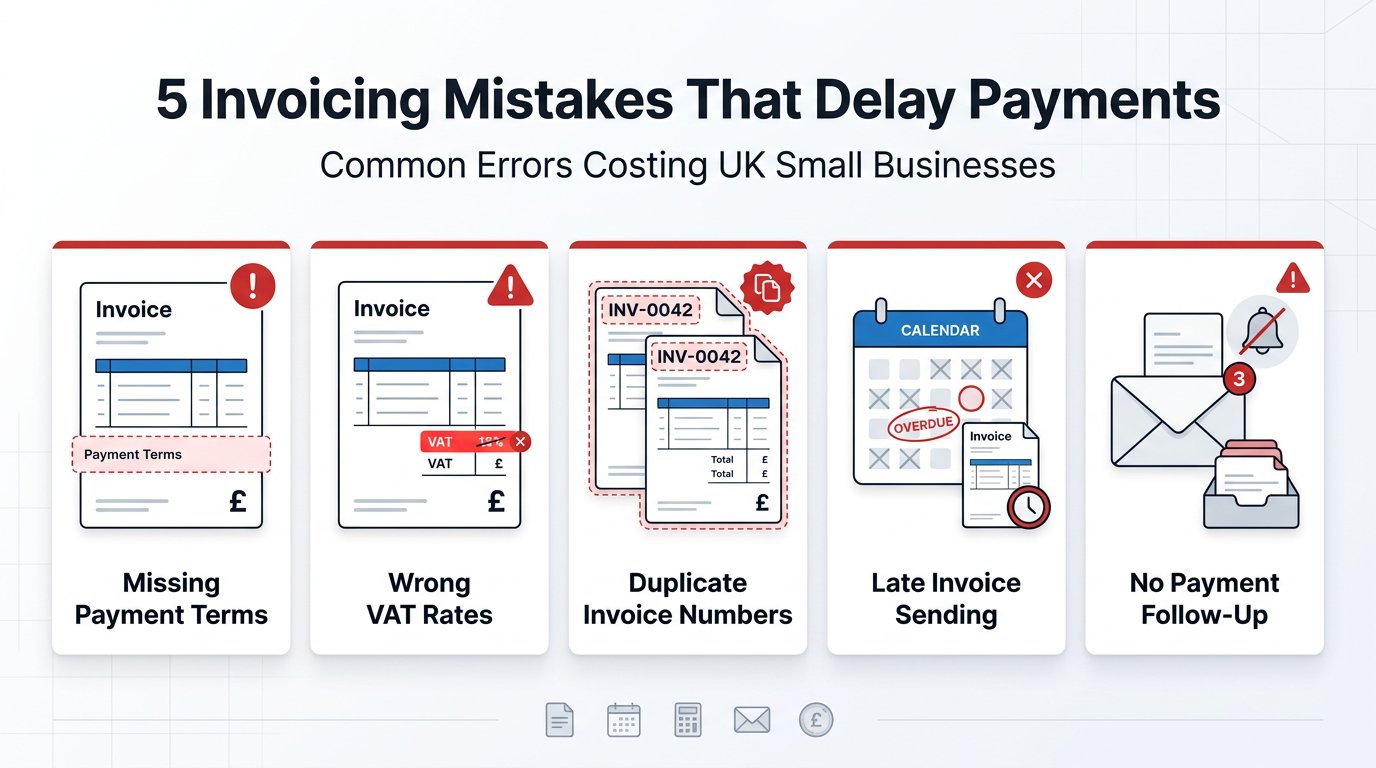
This guide covers the five most common invoicing mistakes that cause payment delays for UK small businesses, explains why each one matters, and shows you how to fix it so your invoices actually get paid on time.
The real cost of invoice mistakes
Before looking at the specific mistakes, it helps to understand why invoice errors cause such disproportionate damage to small businesses compared to larger ones.
When a large company sends a flawed invoice, their accounts receivable team catches it, fixes it, and resends it. The cash flow impact is minor because they have reserves. When a sole trader or small business sends a flawed invoice, the consequences are different. The client queries it, the business owner has to find time to fix it, the payment gets pushed back by days or weeks, and the cash that was supposed to cover rent, wages, or tax is suddenly not there.
The Federation of Small Businesses found that almost two-thirds of invoices sent by UK small businesses in the past year were paid late. The average delay is now 32 days beyond agreed terms. That is not just a number. That is a month of cash flow pressure that many small businesses cannot absorb.
| Late payment impact | Scale |
|---|---|
| Total owed to UK SMEs in overdue invoices | £26 billion at any given time |
| Average overdue amount per affected business | £17,000 |
| SMEs unable to pay staff on time due to late payments | 42% |
| SMEs that paused hiring due to cash flow delays | 24% |
| Businesses closing per year due to late payments | 14,000 (38 per day) |
| Average payment delay beyond agreed terms | 32 days |
| Annual cost to UK economy | £11 billion |
Every single invoicing mistake in this article makes those numbers worse. And every fix makes them better.
The five mistakes
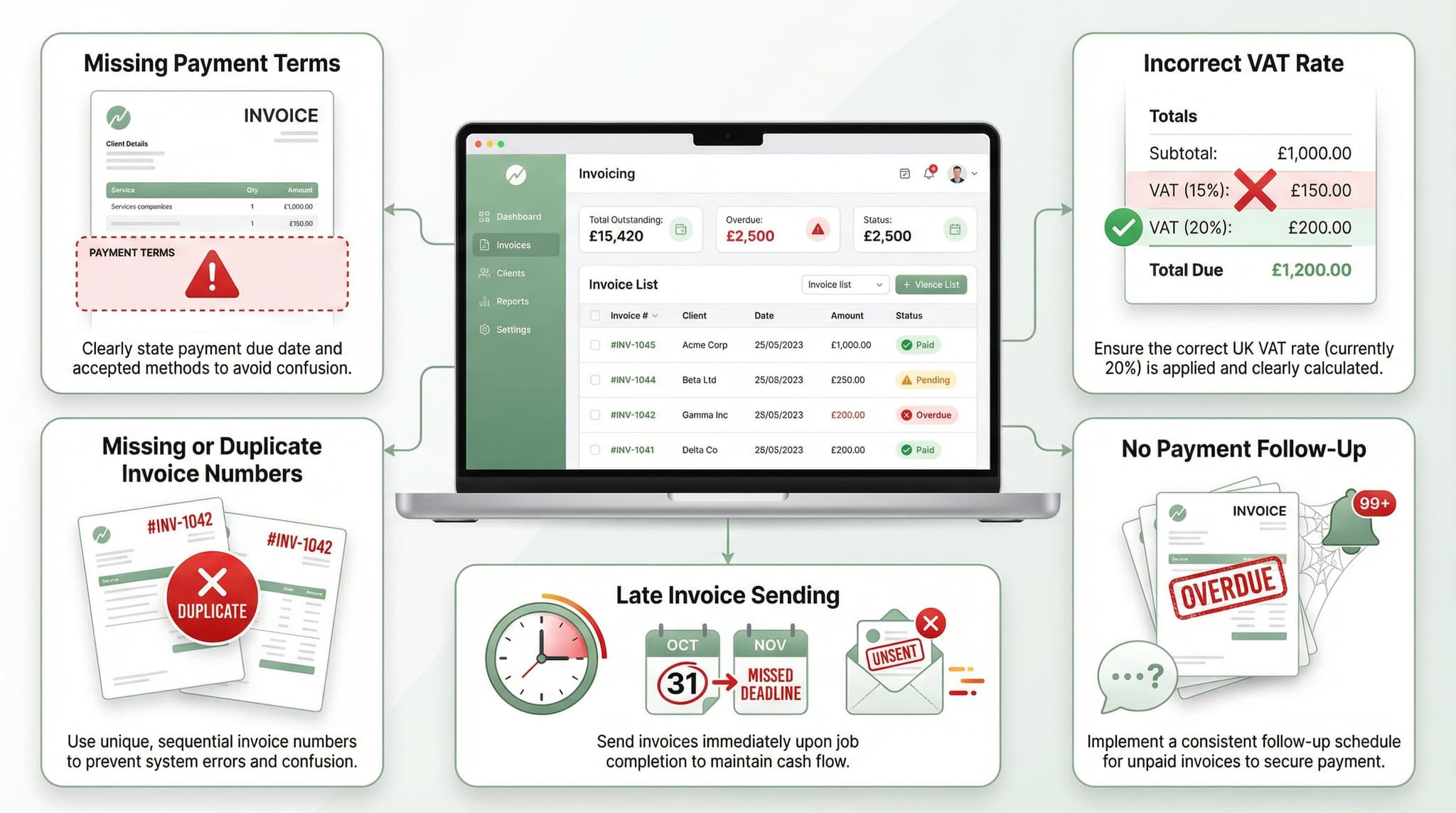
Missing or vague payment terms
This is the most common invoicing mistake in the UK, and it causes more payment delays than any other single error. If your invoice does not clearly state when payment is due, the client will pay when it suits them. That might be 30 days. It might be 90. It might be never, until you chase.
Many small businesses send invoices that say nothing about payment terms at all. Others use vague language like "payment due on receipt" or "please pay promptly," which sound professional but give the client no actual deadline. Without a specific date or a clear net-days term, there is no expectation to meet and no basis for a late payment conversation.
Under UK law, if you do not agree payment terms with a customer, the default is 30 days from either the delivery of goods or services, or 30 days from when the customer receives the invoice, whichever is later. But relying on the legal default is a weaker position than stating your own terms clearly on every invoice.
How to fix it: State payment terms explicitly on every invoice. Use a specific due date ("Payment due by 14 April 2026") or a clear net-days term ("Payment terms: Net 14" or "Payment terms: Net 30"). Include the due date in a prominent position, not buried in small print. If you charge late payment interest, state that on the invoice too. UK businesses can charge statutory interest of 8% plus the Bank of England base rate on overdue B2B invoices, plus a fixed compensation amount for recovery costs.
Wrong VAT rates or missing VAT details
If you are VAT-registered in the UK, issuing an invoice with the wrong VAT rate, missing VAT number, or unclear VAT breakdown does not just delay payment. It can make the entire invoice invalid for HMRC purposes, which means your client cannot reclaim their input VAT from it. That makes them less likely to pay it quickly, more likely to query it, and more likely to send it back for correction.
HMRC requires that a full VAT invoice includes your VAT registration number, the VAT rate applied to each item, the net amount before VAT, the VAT amount, and the gross total. If you supply items at different VAT rates — standard, reduced, zero-rated, or exempt — each rate must be shown separately. Missing any of these details can invalidate the invoice.
This mistake happens most often when businesses create invoices manually, use generic templates that were not designed for UK VAT rules, or apply the wrong rate because they are unsure whether a product or service is standard-rated, reduced, or zero-rated.
How to fix it: Use accounting software that automatically calculates and applies the correct VAT rate based on the product or service category. Make sure your VAT number is displayed on every invoice. If you supply a mix of differently rated items, check that each line item shows its own VAT treatment. Review your invoice template against HMRC's requirements for full VAT invoices to confirm nothing is missing. If you are unsure about the correct VAT rate for what you sell, check HMRC's guidance or ask your accountant before sending the invoice.
No unique invoice number
Every invoice you issue in the UK must have a unique identification number. This is not optional. It is a legal requirement. The number must follow a sequential pattern so that it is clear your invoices form an unbroken series.
Despite this, many small businesses still send invoices without proper numbering, use duplicate numbers, or use numbering systems that are inconsistent and confusing. This causes two problems. First, it makes it harder for clients to reference and process your invoice internally, which slows down their payment workflow. Second, it creates record-keeping issues for both you and your client, which can cause complications during VAT returns, audits, or Self Assessment preparation.
Large clients with structured accounts payable processes will often reject or query invoices that have no unique number, a duplicate number, or a number that looks inconsistent with previous invoices. That rejection means a delay, and the delay means you wait longer for your money.
How to fix it: Use a consistent, sequential invoice numbering system. Accounting software handles this automatically. If you are creating invoices manually, decide on a format (for example, INV-001, INV-002, or 2026-0001, 2026-0002) and never reuse or skip numbers. Make the invoice number clearly visible on the document. If you have multiple income streams or business areas, you can use different prefixes, but each series must still be sequential and unbroken.
Sending invoices late
This is one of the most damaging mistakes because it is entirely self-inflicted. If you deliver a service in the first week of March but do not send the invoice until the last week of March, you have already given yourself a three-week delay before the client's payment clock even starts.
Many small business owners and freelancers delay invoicing because they are busy doing the actual work, because invoicing feels like admin they will "get to later," or because they batch all their invoices at the end of the month. Every day you delay sending an invoice is a day added to the time before you get paid.
The maths is simple. If your payment terms are Net 30 and you send the invoice 14 days after completing the work, you are effectively waiting 44 days for payment. If you send it the same day or the next day, you are waiting 30 or 31 days. Over a year, that difference compounds into weeks of lost cash flow.
How to fix it: Send the invoice as close to the completion of work or delivery of goods as possible. Ideally, the same day or the next business day. If your workflow involves ongoing projects, invoice at agreed milestones rather than waiting until the project is fully complete. Use accounting software with mobile invoicing so you can create and send invoices immediately, even from a phone. Set a personal rule: never let an unbilled piece of completed work sit for more than 24 hours.
No follow-up process for overdue invoices
Sending an invoice and then waiting passively for payment is one of the most common patterns among small businesses that struggle with cash flow. Many business owners feel uncomfortable chasing money because it feels confrontational. Others simply forget which invoices are overdue because they do not have a system for tracking them.
The result is the same either way. Invoices that are not followed up get paid last. Clients with limited cash prioritise the suppliers who chase. That is not cynical. That is how accounts payable departments work in practice. The squeaky wheel gets the payment.
Research shows that 63% of UK small businesses spend significant time chasing overdue payments, costing up to £5,200 per year in lost time and resources. But the businesses that chase systematically get paid faster than the ones that chase sporadically or not at all.
How to fix it: Build a simple follow-up process with three touchpoints. First, send a friendly reminder 3 to 5 days before the due date. Second, send a firmer reminder the day after the due date. Third, escalate with a formal overdue notice 7 to 14 days after the due date that references your right to charge statutory interest. Accounting software can automate all three of these reminders so you never have to remember or feel awkward about chasing. The software does it for you.
What a correct UK invoice must include
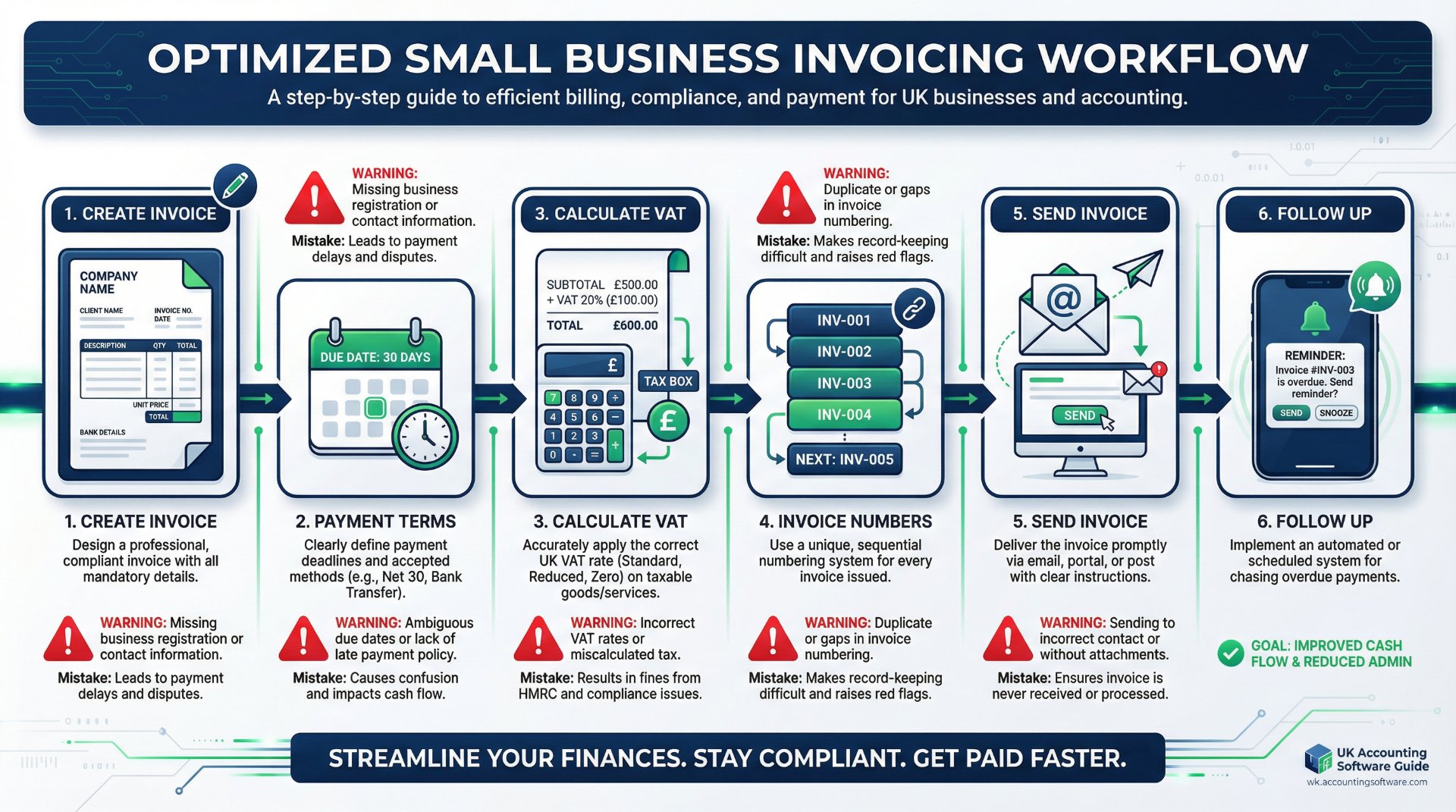
To avoid these five mistakes, it helps to have a clear checklist of what every UK invoice needs. HMRC requirements differ slightly depending on whether you are VAT-registered, but the core elements apply to all business invoices.
| Invoice element | Required for all invoices | Additional for VAT invoices |
|---|---|---|
| Unique sequential invoice number | Yes | Yes |
| Your business name and address | Yes | Yes |
| Client name and address | Yes | Yes |
| Invoice date | Yes | Yes |
| Date of supply (tax point) | Recommended | Yes |
| Description of goods or services | Yes | Yes |
| Quantity and unit price | Yes | Yes |
| Total amount due | Yes | Yes |
| Payment terms and due date | Strongly recommended | Strongly recommended |
| Your VAT registration number | No | Yes |
| VAT rate per item | No | Yes |
| Net total, VAT total, gross total | No | Yes |
How accounting software prevents all five mistakes
Every single mistake in this article can be prevented by using proper invoicing or accounting software. That is not a sales pitch. It is a practical observation about where these errors come from and how they are most reliably eliminated.
Payment terms
Software lets you set default payment terms once. Every invoice you send automatically includes your chosen terms and calculates the due date. No more forgetting or leaving it vague.
VAT accuracy
Software applies the correct VAT rate based on product or service categories, includes your VAT number on every invoice, and calculates net, VAT, and gross totals automatically.
Invoice numbering
Software generates sequential, unique invoice numbers automatically. You never have to think about it, and there is no risk of duplicates or gaps.
Speed of sending
Software lets you create and send invoices in minutes from your desktop or phone, so you can bill clients immediately after completing work rather than batching everything later.
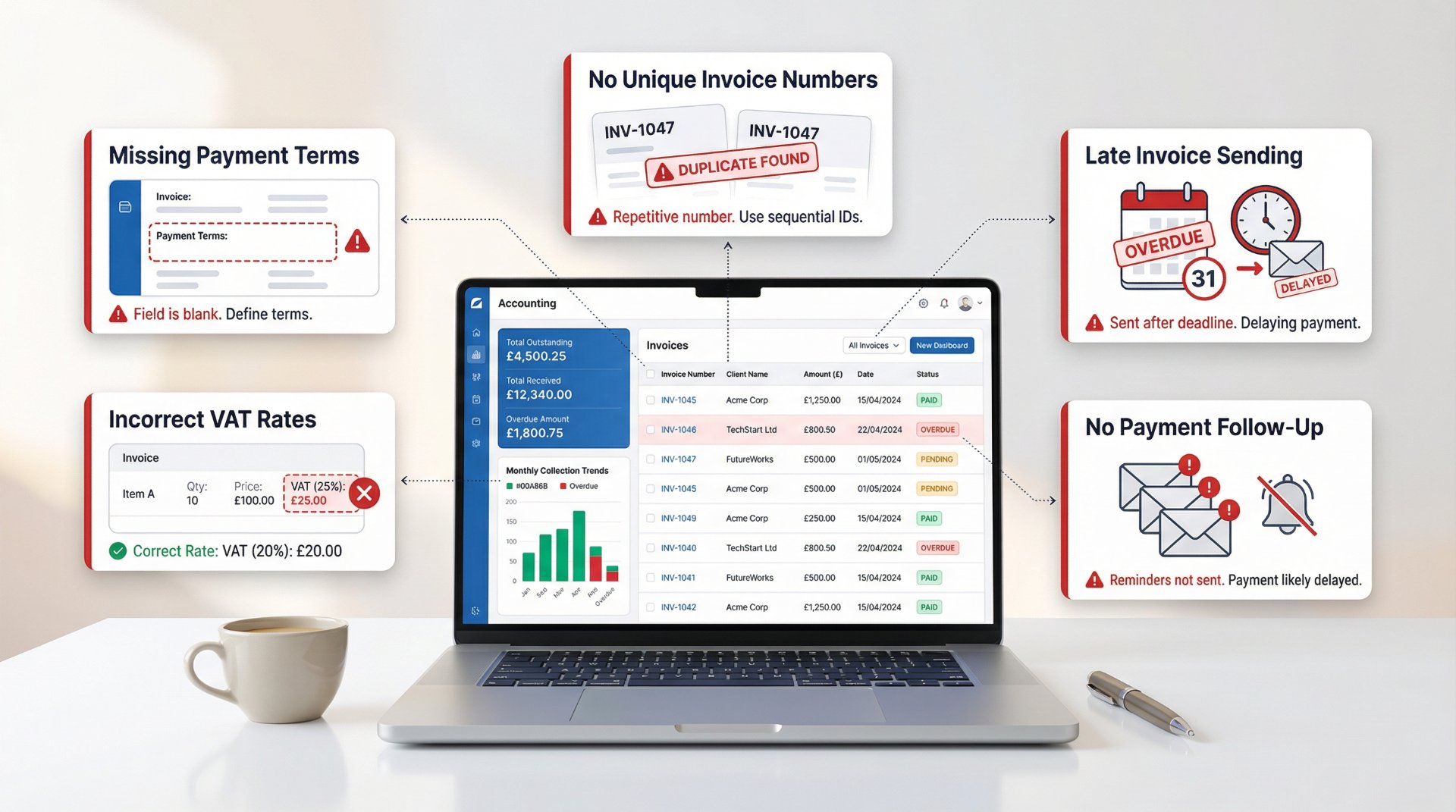
The fifth mistake — no follow-up — is also solved by software. Most modern accounting platforms include automated payment reminders that send polite nudges before and after the due date. Some, like Sage Copilot, go further by actively monitoring overdue invoices and chasing payments on your behalf without you needing to remember or intervene.
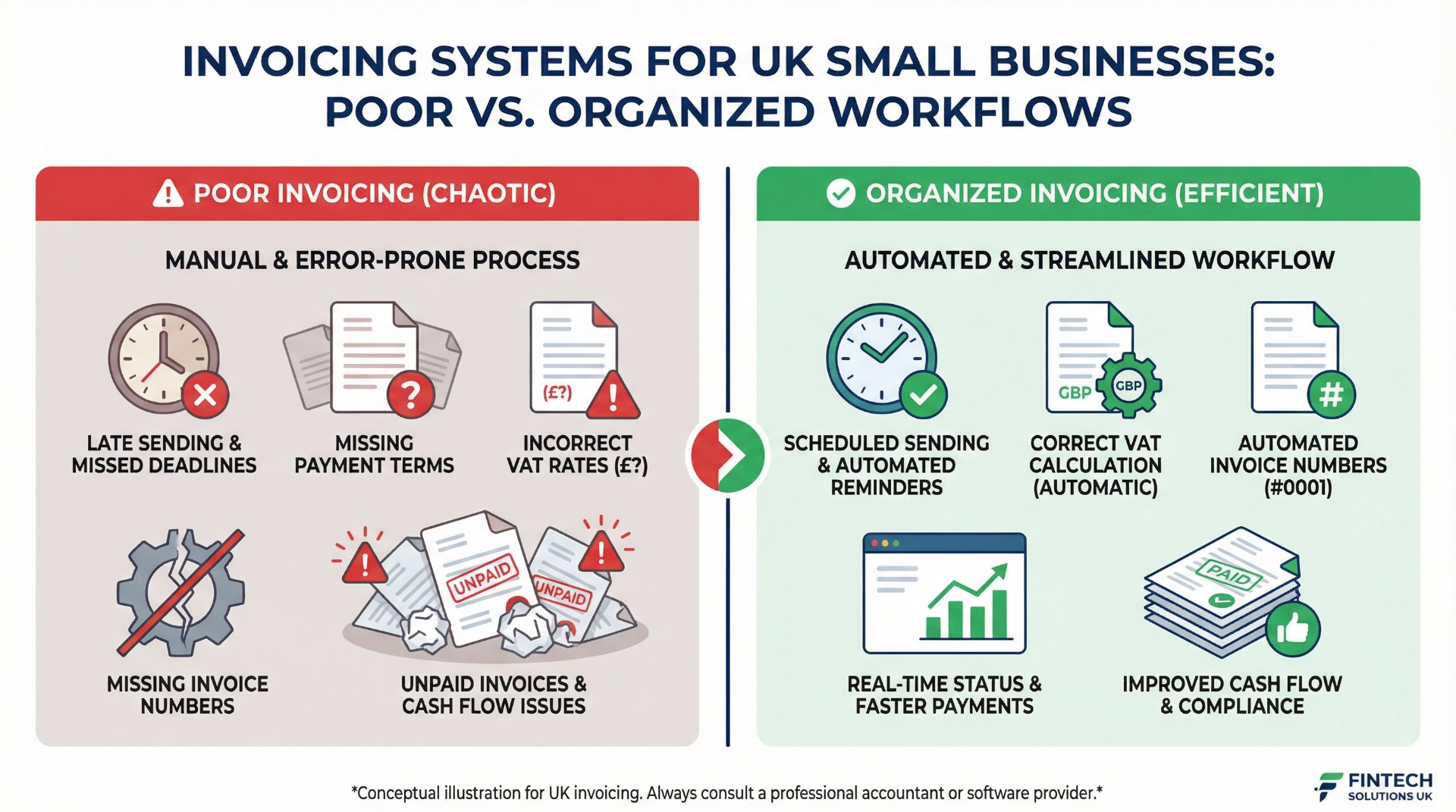
The pattern is clear: manual invoicing creates errors. Errors create queries. Queries create delays. Delays create cash flow problems. Software breaks that cycle at the first step.
Your statutory rights on late payments
Many UK small business owners do not realise they have legal rights when invoices are paid late. Understanding these rights strengthens your position and gives your follow-up process real teeth.
| Right | What it means |
|---|---|
| Statutory interest | You can charge interest on overdue B2B invoices at 8% plus the Bank of England base rate per year. |
| Fixed compensation | You can claim a fixed amount for the cost of recovering late payments: £40 for debts up to £999.99, £70 for debts between £1,000 and £9,999.99, and £100 for debts of £10,000 or more. |
| Reasonable recovery costs | If your recovery costs exceed the fixed compensation amount, you can claim the difference as a reasonable cost. |
| Default payment deadline | If no terms are agreed, payment is legally due 30 days after delivery or receipt of the invoice, whichever is later. |
You do not need to go to court to exercise these rights. Simply referencing them clearly on your invoices and in your overdue reminders is usually enough to encourage faster payment. Clients who know you understand your rights are less likely to deprioritise your invoice.
A simple invoicing checklist
Use this checklist every time you send an invoice. If you can tick every box, you have eliminated the five most common causes of payment delays.
Before sending
- Invoice has a unique sequential number.
- Your business name, address, and contact details are correct.
- Client name and address are correct.
- Invoice date and date of supply are included.
- Description of goods or services is clear and specific.
- Quantities, unit prices, and line totals are accurate.
- VAT number is shown (if VAT-registered).
- VAT rate, net total, VAT total, and gross total are correct.
- Payment terms and due date are clearly stated.
- Late payment interest policy is mentioned.
- Bank details or payment link are included.
After sending
- Pre-due-date reminder is scheduled (3 to 5 days before).
- Overdue reminder is scheduled (1 day after due date).
- Escalation notice is scheduled (7 to 14 days after due date).
- Invoice status is tracked in your accounting software.
What happens next
The UK government's proposed reforms will make a meaningful difference to late payment culture over time. Maximum payment terms of 60 days reducing to 45 days, spot checks by the Small Business Commissioner, and mandatory interest charges will all put pressure on slow-paying clients to clean up their processes.
But none of those reforms will fix your invoices for you. The five mistakes in this article are all within your control. Fix them, and you remove the most common reasons clients have to delay, query, or deprioritise your invoices.
The simplest way to fix all five at once is to use accounting software that handles numbering, VAT, terms, sending, and follow-up automatically. That way, invoicing stops being a source of cash flow risk and becomes what it should always have been: a clean, reliable process that gets you paid on time.