◆ AI-Driven Accounting: Precision at Scale
How intelligent automation is turning finance teams into faster, sharper, and more strategic operators — without sacrificing control.
Accounting used to be defined by repetition: exporting transactions, coding expenses, matching payments, chasing missing receipts, reconciling bank statements, and assembling reports at month-end. Software improved speed, but much of the work still depended on human effort, manual checking, and delayed visibility.
AI-driven accounting changes the foundation. It does not simply “do accounting faster.” It introduces precision at scale — consistent categorization, automated matching, anomaly detection, and reporting that stays current as the business moves. For growing organizations, this is the difference between staying in control and constantly catching up.
▸ What “Precision at Scale” Actually Means
Precision at scale is the ability to maintain accuracy as complexity increases. As transaction volume grows, more vendors are added, more payment methods appear, multiple entities and departments emerge, and compliance becomes more demanding — the probability of mistakes rises dramatically. AI-driven accounting reduces that risk by standardizing and continuously improving the way financial data is processed.
Automated categorization Smart reconciliation Anomaly detection Real-time reporting Predictive forecasting▸ Why Traditional Accounting Breaks Under Growth
Most accounting teams don’t struggle because they lack skill. They struggle because the system they are using is built for a smaller version of the business. When the volume increases, small weaknesses become structural problems.
| Growth Pressure Point | What Happens in Manual / Basic Systems | Why It Becomes Expensive |
|---|---|---|
| Higher transaction volume | More manual coding and reconciliation | Finance becomes a bottleneck; errors increase |
| More vendors & subscriptions | Inconsistent categorization and duplicate entries | Reporting becomes unreliable, cost control weakens |
| Multiple departments | Unclear allocations; budget tracking becomes messy | Leaders make decisions with partial visibility |
| Faster decision cycles | Month-end reporting is too slow | Decisions are based on outdated numbers |
| Compliance complexity | Audit trails are incomplete and approvals are informal | Risk exposure increases; audits become painful |
▸ The Core AI Capabilities Changing Accounting
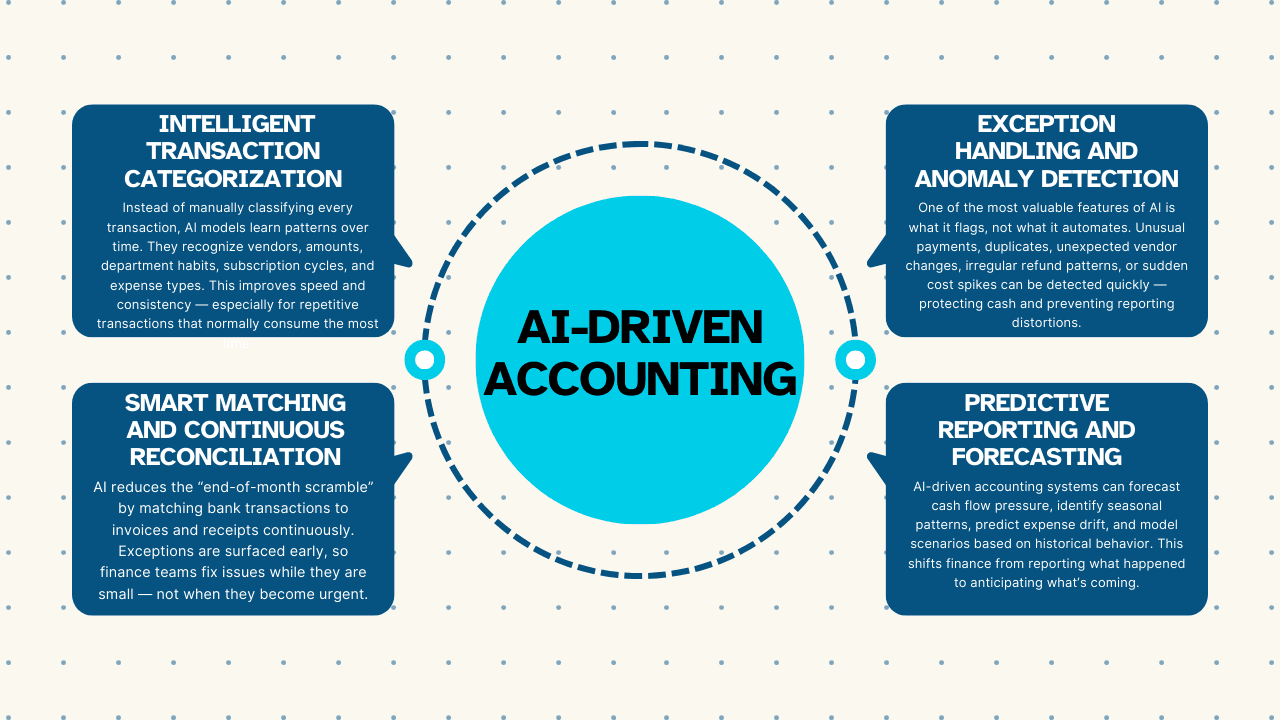
◉ Intelligent Transaction Categorization
Instead of manually classifying every transaction, AI models learn patterns over time. They recognize vendors, amounts, department habits, subscription cycles, and expense types. This improves speed and consistency — especially for repetitive transactions that normally consume the most time.
◉ Smart Matching and Continuous Reconciliation
AI reduces the “end-of-month scramble” by matching bank transactions to invoices and receipts continuously. Exceptions are surfaced early, so finance teams fix issues while they are small — not when they become urgent.
◉ Exception Handling and Anomaly Detection
One of the most valuable features of AI is what it flags, not what it automates. Unusual payments, duplicates, unexpected vendor changes, irregular refund patterns, or sudden cost spikes can be detected quickly — protecting cash and preventing reporting distortions.
◉ Faster, Cleaner Close Cycles
When reconciliation and categorization happen throughout the month, closing becomes more about review than reconstruction. This accelerates reporting and improves trust in the numbers.
◉ Predictive Reporting and Forecasting
AI-driven accounting systems can forecast cash flow pressure, identify seasonal patterns, predict expense drift, and model scenarios based on historical behavior. This shifts finance from reporting what happened to anticipating what’s coming.
▸ Manual vs AI-Driven Accounting
| Finance Area | Manual / Traditional Approach | AI-Driven Approach |
|---|---|---|
| Transaction coding | Human input for most entries | AI suggests or applies categories consistently |
| Reconciliation | Monthly, time-heavy | Ongoing, with exceptions flagged |
| Errors | Found late during review | Detected early via anomaly checks |
| Reporting | Static snapshots | Live dashboards and real-time views |
| Planning | Basic projections | Scenario modeling and predictive signals |
▸ The Business Impact: What Improves When Accounting Gets Smarter
◉ Better Cost Control
When expenses are categorized consistently and monitored continuously, businesses can spot leakage early — whether it’s unused software, vendor creep, uncontrolled spend, or duplicated services.
◉ Stronger Cash Flow Discipline
Accurate receivables and payables visibility supports better timing decisions. Companies can forecast shortfalls, adjust spending, accelerate collections, and avoid surprise liquidity pressure.
◉ Higher Trust in Numbers
Leadership teams stop debating accuracy and start acting on insight. When finance becomes reliable, strategic decisions move faster and with more confidence.
◉ Compliance Readiness Becomes Routine
AI-driven systems often include structured audit trails, approvals, and standardized reporting — reducing the chaos that typically surrounds audits and filings.
▸ What AI Will Not Fix (Unless the Structure Is Right)
AI improves accounting — but it cannot replace financial discipline.
If a company’s chart of accounts is inconsistent, approvals are unclear, expense policies are weak, or data is scattered across disconnected systems, AI will not magically produce clean reporting. It will automate confusion faster.
Precision at scale requires structure: consistent categories, clear ownership, defined processes, and reliable data inputs.
▸ A Smarter Finance Function Is a Competitive Advantage
AI-driven accounting is not just an upgrade for finance teams — it is an upgrade for the entire business. It reduces friction, improves accuracy, and turns financial reporting into a continuous, decision-ready system.
As businesses scale, complexity is guaranteed. The question is whether finance scales with it. When accounting becomes intelligent, companies stop operating in hindsight and start operating with clarity.
That is precision at scale — and it is quickly becoming the new standard.