Beyond Basic Bookkeeping: How Sage Supports Strategic Financial Control
◆ Beyond Basic Bookkeeping: How Sage Supports Strategic Financial Control
A deep dive into moving from “recording transactions” to forecasting, compliance confidence, and scalable reporting.
Most businesses start with bookkeeping as the goal: send invoices, record expenses, reconcile the bank, and keep things tidy for tax season. That’s a valid starting point. But as a business grows, “tidy” becomes a risky definition of success. Volume increases, teams expand, subscriptions multiply, and cash flow timing becomes more sensitive. At that point, accounting must evolve from record-keeping into control.
Strategic financial control means you can answer important questions quickly and confidently: Where is cash really going? Which services are profitable? What will the next 90 days look like? Are we compliant without last-minute panic? Sage is often used by growing businesses to build that structure—through automation, real-time reporting, and workflow discipline that can scale.
Strategic financial control is not “more reporting.” It’s faster truth, clear ownership, and predictable processes as complexity increases.
▸ Why “Basic Bookkeeping” Breaks Under Growth
Bookkeeping tools and spreadsheet-heavy workflows often fail quietly. Not because they stop working, but because they stop keeping up. The business becomes faster than the finance function, and that gap turns into risk.
| Growth Pressure | What Usually Happens | Real-World Impact |
|---|---|---|
| More transactions & vendors | Manual coding becomes inconsistent | Reports look “fine” but are not decision-grade |
| Multiple products/services | Costs aren’t allocated properly | Profitability becomes guesswork |
| Cash flow complexity | Receivables/payables visibility is delayed | Surprise cash gaps appear late |
| Compliance requirements increase | Audit trails and approvals remain informal | Higher exposure to errors, penalties, rework |
| Team expansion | Spreadsheets create version confusion | Finance becomes a bottleneck for leadership |
▸ What Sage Changes: From Recording to Controlling
Sage supports a shift from basic accounting to structured financial management by tightening the link between transactions, reporting, and governance. The goal is not to “add complexity,” but to make complexity manageable.
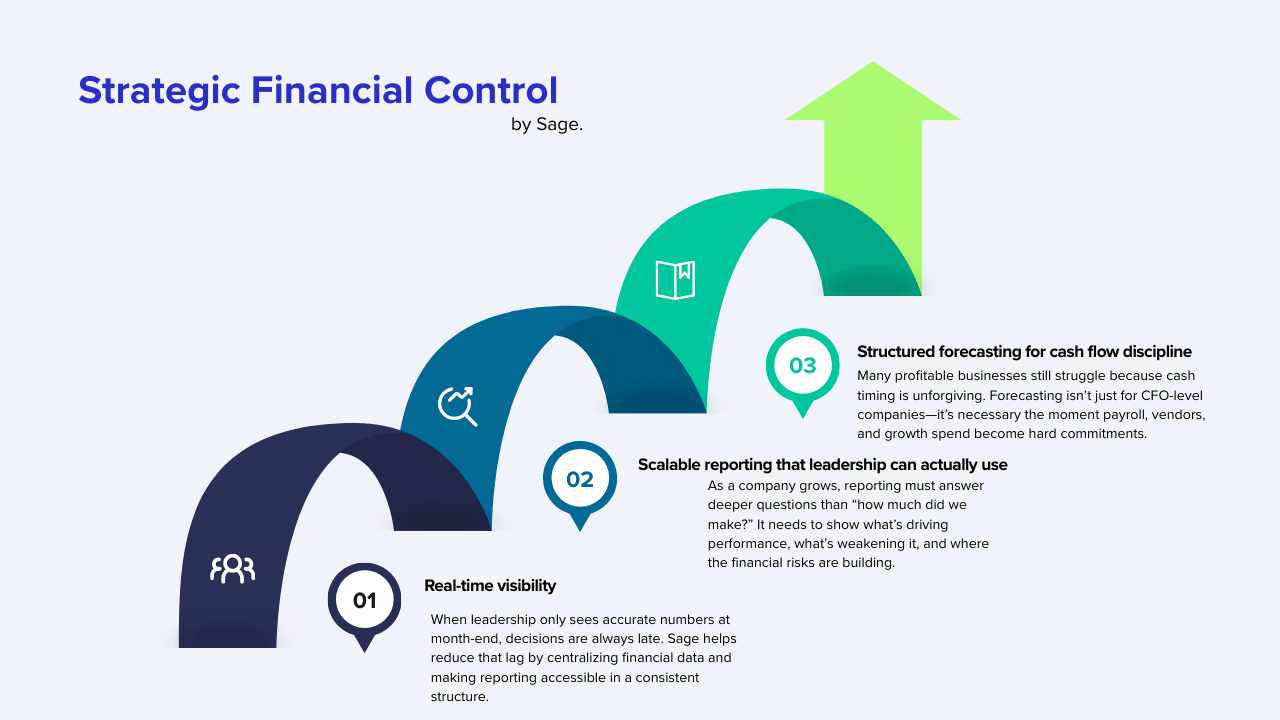
◉ 1) Real-time visibility, not month-end surprises
When leadership only sees accurate numbers at month-end, decisions are always late. Sage helps reduce that lag by centralizing financial data and making reporting accessible in a consistent structure.
- Faster performance signals so leaders see trends early (spend drift, margin pressure, revenue timing).
- Cleaner categorization improves report accuracy—especially when rules and recurring entries are used properly.
- Less “report reconstruction” at the end of the month because the system stays closer to current reality.
◉ 2) Scalable reporting that leadership can actually use
As a company grows, reporting must answer deeper questions than “how much did we make?” It needs to show what’s driving performance, what’s weakening it, and where the financial risks are building.
| Reporting Need | Basic Bookkeeping Output | Strategic Control Output |
|---|---|---|
| Profitability clarity | Overall profit only | Profit by service line / customer group (when structured properly) |
| Cost discipline | Expenses listed | Expenses mapped to categories that support decisions |
| Cash awareness | Bank balance | Cash position + receivables/payables timing |
| Performance management | Static monthly report | Consistent reporting rhythm and faster close cycles |
◉ 3) Structured forecasting for cash flow discipline
Many profitable businesses still struggle because cash timing is unforgiving. Forecasting isn’t just for CFO-level companies—it’s necessary the moment payroll, vendors, and growth spend become hard commitments.
A practical approach: treat forecasting like a workflow, not a spreadsheet project.
- Set a rhythm: weekly review of cash position and near-term obligations.
- Track receivables timing: what is due, what is delayed, and what is at risk.
- Model spending decisions: hiring, marketing, inventory, and recurring tools.
With the right setup, Sage reporting helps finance teams build a consistent view of what’s happening now and what’s likely to happen next—so decisions are made before cash pressure forces them.
◉ 4) Compliance confidence through process and auditability
Compliance problems usually come from weak process, not bad intentions. When entries are manual, approvals are informal, and documentation lives in email threads, compliance becomes stressful and unpredictable.
Structured accounting software supports compliance by creating clearer records, consistent categorization, and repeatable workflows. This matters most when the business grows and more people touch financial processes.
| Compliance Risk | What Causes It | How Structure Helps |
|---|---|---|
| Inconsistent VAT / tax entries | Manual coding and rushed month-end corrections | Standard categories, better consistency, cleaner review cycles |
| Poor audit trail | Receipts scattered, approvals unclear | Central records + clearer workflows |
| Late or incorrect filings | Reporting delays and reconciliations done too late | Faster close, fewer last-minute surprises |
▸ The Real Upgrade: Internal Controls That Don’t Slow You Down
Controls are often viewed as “red tape.” But the best controls are invisible—they prevent mistakes without creating friction. Sage supports a shift toward control by making processes repeatable and reducing reliance on memory and manual checking.
◉ Practical controls that scale well
- Clear chart of accounts design so categories match how leadership thinks about the business.
- Consistent expense coding rules to reduce messy reporting and reclassification.
- Regular reconciliation cadence so data stays accurate throughout the month.
- Simple approval expectations so spending stays aligned with budgets and priorities.
▸ Common Mistakes That Limit Value (Even With Good Software)
Software can’t compensate for unclear structure. When companies feel their accounting system isn’t helping, the problem is often configuration and discipline—not the platform itself.
| Mistake | What It Looks Like | What It Causes |
|---|---|---|
| Over-complicated categories | Too many accounts and inconsistent usage | Confusing reporting, slow month-end |
| Under-structured coding | Everything goes into generic buckets | No real insight, just totals |
| Reconciliation left until late | “We’ll fix it at month-end” | Surprises, stress, inaccurate decisions |
| No reporting rhythm | Reports created only when needed | Reactive leadership and delayed action |
▸ A Simple “Strategic Control” Blueprint
If your goal is to move beyond bookkeeping, the most effective path is usually structured in three layers:
◉ Layer 1: Clean data
- Consistent categories and coding rules
- Regular reconciliations
- Accurate receivables and payables tracking
◉ Layer 2: Reliable reporting
- Reports aligned to leadership questions (not just accounting terms)
- Repeatable reporting schedule (weekly cash view + monthly performance)
- Clear variance review: what changed, why it changed, what to do next
◉ Layer 3: Forward control
- Cash forecasting discipline
- Budget accountability
- Early risk detection (spend drift, margin compression, cash gaps)
▸ Conclusion: The Real Value Is Financial Confidence
Basic bookkeeping tells you what happened. Strategic financial control tells you what it means—and what to do next. As a business grows, that difference becomes critical. Sage can support this shift by helping teams centralize financial data, maintain consistency, speed up reporting, strengthen compliance readiness, and build structured forecasting habits.
When finance moves beyond recording and into control, leadership stops guessing and starts operating with clarity.