Making Tax Digital for Income Tax: The Full UK Implementation Guide
A practical long-form guide for sole traders and landlords preparing for MTD for Income Tax in the UK.
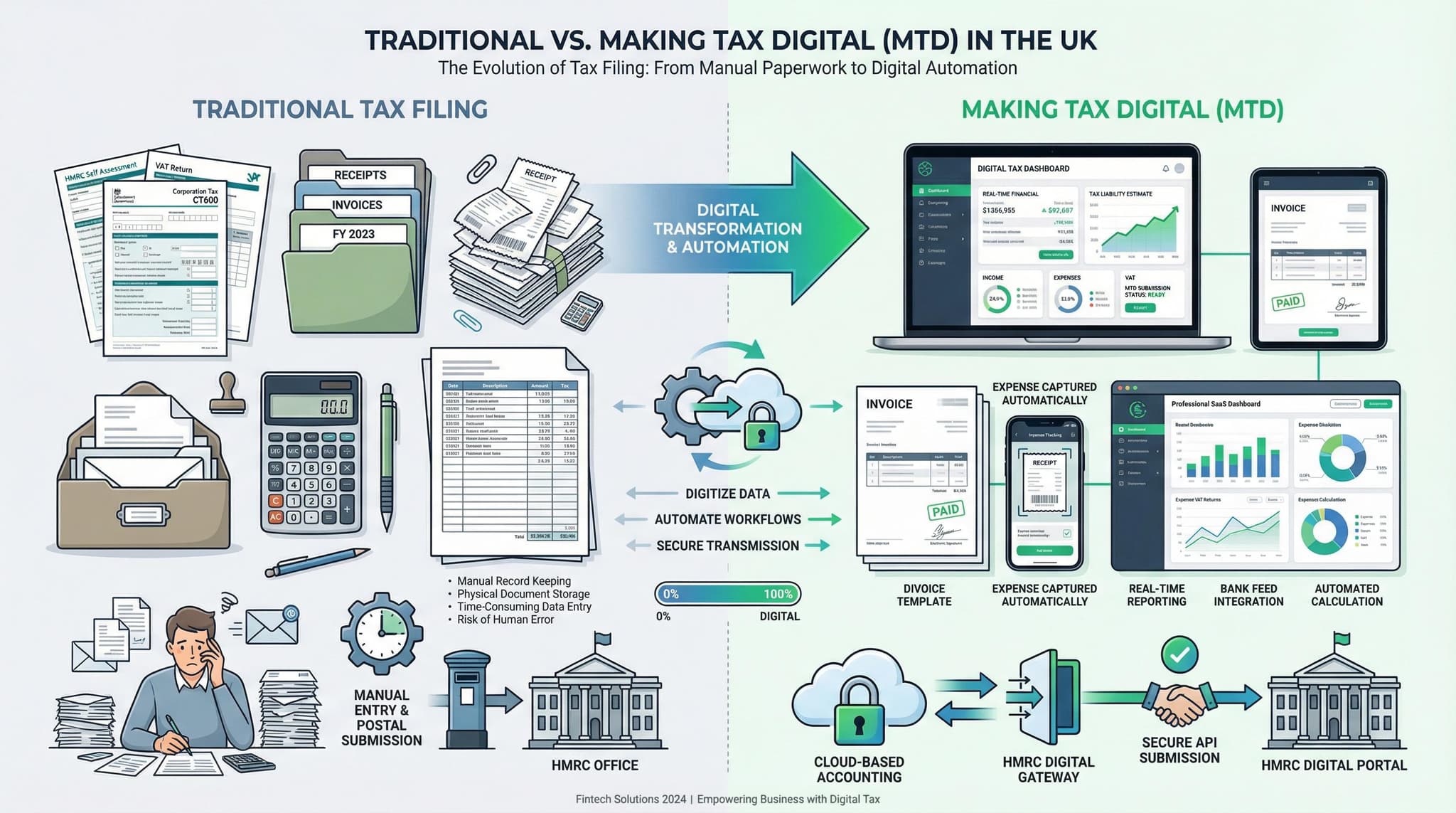
Making Tax Digital for Income Tax: The Full UK Implementation Guide
Making Tax Digital for Income Tax is one of the biggest structural changes to the UK tax system for self-employed individuals and landlords in decades. From April 2026, many taxpayers who currently file a single annual Self Assessment return will move into a more digital reporting model built around software, digital records, quarterly updates, and an end-of-year finalisation process. For some people this will be a manageable software change. For others it will require a complete redesign of how records are kept, reviewed, corrected, and submitted across the tax year.
The challenge is that MTD for Income Tax is often explained in fragments. One article talks about thresholds. Another talks about quarterly submissions. Another mentions exemptions or compatible software. That leaves many taxpayers with an incomplete picture. This guide brings the full implementation logic together in one place, so you can understand who is affected, when the rules apply, what must be submitted, how the deadlines work, and what a practical transition plan should look like.
This guide is written for UK sole traders, landlords, agents, and advisers who want a serious operational understanding of the new rules rather than a short summary. It focuses on real implementation questions: whether you are in scope, what counts as qualifying income, how quarterly updates work, what still happens at year end, when penalties apply, and what steps to take before the first mandated start date.

What MTD for Income Tax is
Making Tax Digital for Income Tax is HMRC's new digital reporting framework for individuals with self-employment income, property income, or both. Instead of waiting until after the end of the tax year to build the full picture, taxpayers in scope will maintain digital records throughout the year and submit summary updates every quarter using compatible software. At the end of the year, they will still need to finalise their position, include any necessary adjustments, and complete their annual tax obligations through the software process.
This is important because quarterly updates are not mini tax returns in the traditional sense. They are periodic summaries of income and expenses drawn from the digital records already created during the year. HMRC receives totals by category rather than every underlying transaction line. That means the new model is not four full tax returns plus one extra. It is better understood as digital record-keeping plus quarterly reporting plus annual finalisation.
The policy direction behind MTD is to reduce manual record-keeping, improve the accuracy of tax data, make corrections easier during the year, and move taxpayers into a more software-driven compliance model. Whether it achieves all of those goals in practice will depend heavily on software quality and taxpayer readiness, but the direction of travel is clear and now time-bound.
Who needs to use it
HMRC says you will need to use Making Tax Digital for Income Tax if all of the following apply: you are a sole trader or landlord registered for Self Assessment, you receive income from self-employment or property or both, and your qualifying income is above the relevant threshold. The start date then depends on the level of qualifying income in the relevant tax year.
| Threshold test | Start date | What it means |
|---|---|---|
| Qualifying income over £50,000 in 2024 to 2025 | 6 April 2026 | You must begin using MTD for Income Tax from the start of the 2026 to 2027 tax year. |
| Qualifying income over £30,000 in 2025 to 2026 | 6 April 2027 | You must begin using MTD for Income Tax from the start of the 2027 to 2028 tax year. |
| Qualifying income over £20,000 | Planned future legislation | The government has said it will legislate to lower the threshold, but the detailed timing still needs to be confirmed in law. |
| Partnerships | Later date | Partnerships will come into MTD for Income Tax in the future, but HMRC has not yet announced the implementation timeline. |
One crucial point is timing. HMRC says you do not need to start using MTD for Income Tax until after you have submitted your first Self Assessment tax return. In practical terms, that means a taxpayer moving into the regime from April 2026 will still complete their ordinary 2024 to 2025 filing cycle first, then begin using digital record-keeping and quarterly reporting from the beginning of the next tax year.
HMRC will review your Self Assessment return and assess your qualifying income each tax year. If your income is above the relevant threshold, HMRC says it will write to you to confirm that you need to start using the service by the beginning of the upcoming tax year. However, the responsibility does not sit only with HMRC. If you do not receive a letter, you are still responsible for checking whether you are in scope and preparing on time.
Who is not in scope, or may be exempt
Not everyone with Self Assessment obligations will move into MTD for Income Tax immediately. The rules are currently directed at sole traders and landlords with qualifying income above the relevant thresholds. Partnerships are outside the mandatory start dates announced so far. HMRC also says there are exemptions, including cases where someone is digitally excluded.
If you are exempt, you do not have to use MTD for Income Tax, but that does not remove your tax obligations. You must still report income and gains through Self Assessment. In other words, exemption from the digital process is not exemption from tax reporting itself.
HMRC has also noted that if you used the SA109 supplementary page for your 2024 to 2025 tax return and expect to use it again for your next return, you will not need to use MTD for Income Tax before April 2027. This is one of the reasons blanket assumptions are risky. Some taxpayers who appear likely to be in scope may have special circumstances that change their start date or route into the regime.
What qualifying income means in practice
The threshold is based on qualifying income from self-employment and property, not simply on profit and not on all income from all sources combined. This matters because many taxpayers instinctively compare the threshold to taxable profit, salary, or total income. That can lead to the wrong conclusion.
In practical terms, if you are a sole trader, a landlord, or both, you need to look at the relevant self-employment and property income that counts toward HMRC's test. If those sources place you above the threshold, you may be in scope even if your overall tax position is more complex or includes other income streams such as employment income, dividends, or pensions.
Because the threshold logic is central to implementation, taxpayers near the boundary should not rely on rough estimates. Review the tax year HMRC is using for the threshold test, confirm what counts as qualifying income, and align that with the figures reported in your tax return and bookkeeping records. Borderline cases should be reviewed with an accountant or tax adviser before the start date arrives.
What you actually have to do under MTD
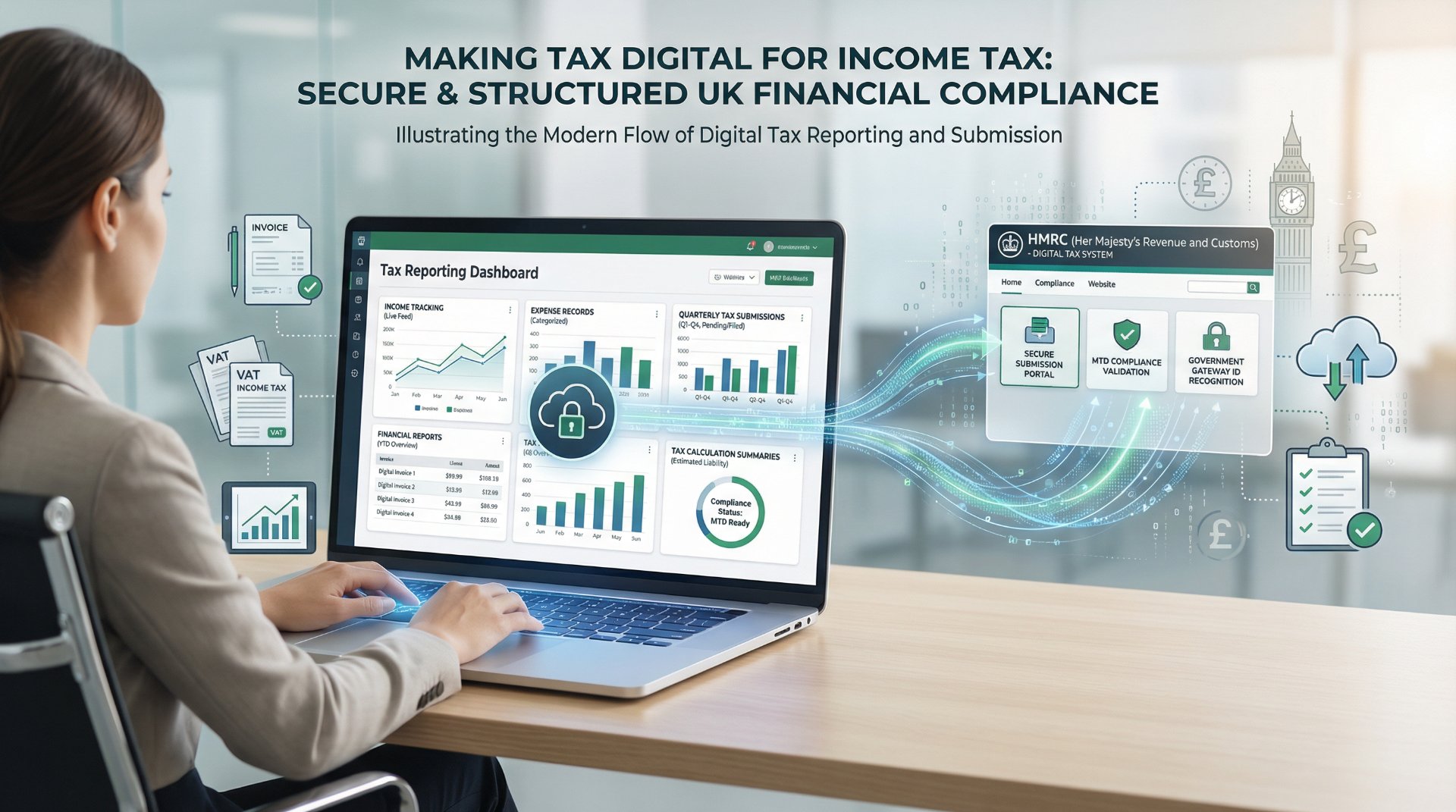
The operational requirements of MTD for Income Tax can be broken into four parts: keep digital records, use compatible software, send quarterly updates, and complete year-end finalisation. Thinking of the regime in these four layers is far more useful than thinking only about deadlines.
1. Keep digital records
Income and expenses for each self-employment and property source must be maintained digitally rather than reconstructed at the end of the year from paper bundles, bank statements, or scattered spreadsheets.
2. Use compatible software
HMRC expects records and submissions to be handled through software that is compatible with MTD for Income Tax. This can be managed directly by the taxpayer or by their accountant or agent.
3. Send quarterly updates
Every 3 months, software totals the relevant digital records for each business or property income source and sends those summaries to HMRC by the required deadline.
4. Finalise the year
At the end of the tax year, you still need to review the full position, make required adjustments, include other income where relevant, and finalise your Income Tax reporting through the software-led process.
How quarterly updates work
Quarterly updates are one of the most misunderstood parts of MTD for Income Tax. HMRC says that every 3 months, your compatible software will add together your digital records for each business you have to create totals for each income and expense category. These totals are what get sent to HMRC as a quarterly update.
You do not need to make accounting or tax adjustments before sending a quarterly update. That is a key design feature. Quarterly updates are meant to reflect the digital records held so far, not a fully adjusted year-end view. HMRC also says that if you have already sent earlier periods and then made corrections, later quarterly updates will include those records from the beginning of the tax year plus any corrections already made. This makes error correction during the year easier and means you do not need to resend the original quarterly update after making a correction.
HMRC does not receive the details of every individual transaction. It receives category totals based on your digital records for that period. That reduces the reporting burden compared with sending line-by-line bookkeeping, but it also means your bookkeeping must be structured correctly inside the software so that the category totals are accurate.
What is included
Quarterly updates include the digital records for your self-employment and property income and expenses from the previous 3 months, together with the records already created since the beginning of the tax year and any corrections made to them. If you have not received any income or incurred any expenses during the last update period, HMRC says you still need to send the quarterly update to tell them.
After sending an update, you will be able to see an estimate of your tax bill for your self-employment and property income in your software or HMRC online services account. That estimated figure can be useful for planning, but taxpayers should remember it is not the final liability until the year is completed and finalised.
Separate income sources matter
Quarterly updates are sent for each self-employment and property income source. This matters for people who have more than one trade, multiple property streams, or jointly let properties. For jointly let properties, HMRC allows a choice in quarterly updates between including all property income and expenses for those properties or including only the property income without expenses, with the expenses then reported at the end of the tax year before finalisation.
Quarterly deadlines
There are two update period models under MTD for Income Tax: standard update periods aligned with the tax year and calendar update periods ending on the last day of a month. The choice matters operationally because it affects how your bookkeeping calendar lines up with your accounting routines.
| Standard update period | Deadline | Calendar update period | Deadline |
|---|---|---|---|
| 6 April to 5 July | 7 August | 1 April to 30 June | 7 August |
| 6 April to 5 October | 7 November | 1 April to 30 September | 7 November |
| 6 April to 5 January | 7 February | 1 April to 31 December | 7 February |
| 6 April to 5 April | 7 May | 1 April to 31 March | 7 May |
If your accounting period aligns with the tax year, HMRC says standard update periods are generally appropriate. If your accounting period does not align with the tax year, for example 1 April to 31 March, calendar update periods may make record keeping simpler. However, the choice must be made in your software before your first update is submitted for the tax year. Once you have sent an update, you cannot switch back until the next tax year.
Taxpayers can also choose to send updates more often than required. For example, some software may allow monthly submissions that cumulatively cover the full update period. That is optional, but it may help businesses or landlords who want more regular visibility over their estimated tax position.
What still happens at year end
One of the common misconceptions about MTD for Income Tax is that quarterly updates completely replace annual tax finalisation. They do not. Quarterly updates are only part of the annual compliance cycle. The taxpayer still needs to review the year's position, make any necessary accounting and tax adjustments, include other income not part of the quarterly update process where relevant, and submit the year-end return through the MTD-compatible software route.
The practical reality is that year-end work does not disappear. It changes shape. Under the old model, many taxpayers left record building, reconciliation, and clean-up until the end of the tax year. Under the new model, more of that work should happen continuously, which means the end-of-year process can become cleaner. But finalisation still matters because quarterly updates are unadjusted summaries, not the final answer.
For taxpayers and agents, this means the best way to prepare is not to treat MTD as a deadlines project. It is a workflow project. If the digital records are incomplete, poorly coded, or left until the last minute, quarterly submissions may still be filed on time, but the year-end process will remain painful.
Penalties and the soft landing on quarterly updates
HMRC says that if you do not send your quarterly update by the relevant deadline, you may get a late submission penalty once you are required to use MTD for Income Tax. However, there is an important transitional relaxation for the first mandatory cohort.
If you need to use MTD for Income Tax from 6 April 2026, HMRC says it will not apply penalty points for late quarterly updates for the first 12 months. That soft landing does not remove the filing obligation itself. You will still need to send the quarterly updates before you can submit your tax return. It also does not remove late tax return penalties, which will still apply.
This distinction is critical. Some taxpayers may hear that quarterly penalties are relaxed and assume that the first year is effectively optional. It is not. The reporting regime still applies. The practical message from HMRC is closer to this: get compliant, get used to the process, and do not rely on the temporary penalty treatment as an excuse to delay implementation.
What software needs to do
Compatible software sits at the centre of MTD for Income Tax. It is not just a filing tool. It becomes the operating system for your digital records, categorisation, updates, corrections, and year-end submission. Choosing the wrong software or implementing it badly will create ongoing friction every quarter.
At minimum, the software needs to support digital record-keeping, quarterly update generation, correction handling, and final tax submission. Beyond that, the best systems will also support bank feeds, receipt capture, property and business separation, accountant collaboration, tax estimation, and workflow visibility. For agents managing multiple clients, software capability becomes even more important because process standardisation across the client base can determine whether MTD is manageable or operationally exhausting.
Taxpayers should also decide early whether the software will be operated directly by them, by their accountant, or as a shared process. That decision affects training, permissions, workflow design, and who is responsible for the accuracy and completeness of records during the year.
Implementation plan for sole traders and landlords
The cleanest implementations start before the first mandated tax year. Businesses that wait until the first quarterly deadline usually find that the real problem is not filing, but poor underlying records. The right preparation sequence is operational rather than purely technical.
Step 1: Confirm whether you are in scope
Review the relevant tax year threshold, your qualifying income, your Self Assessment filing status, and any special circumstances such as exemptions, SA109 usage, or agent-managed arrangements.
Step 2: Decide who owns the process
Decide whether you will manage MTD directly, your accountant will run it for you, or you will use a shared model where bookkeeping is internal and submissions are reviewed externally.
Step 3: Choose compatible software early
Software should be selected and authorised before the mandated start date, not during the first reporting period. If you have separate business and property streams, make sure the system can handle them clearly.
Step 4: Move records into a digital routine
Do not rely on year-end reconstruction. Capture income and expenses continuously, connect bank feeds where possible, and make sure categories map cleanly to the required reporting structure.
Step 5: Choose your update period model
Decide whether standard or calendar update periods best suit your accounting cycle. Make the selection in software before the first quarterly update is filed.
Step 6: Build a quarterly control calendar
Create internal deadlines that sit ahead of HMRC's filing dates. For example, have bookkeeping complete by month-end, internal review within two weeks, and submission before the official deadline.
Step 7: Keep the year-end process alive
MTD does not remove the need for final review. Keep records for adjustments, reliefs, and other income sources organised throughout the year so finalisation is efficient.
Agent and accountant implications
For accountants and tax advisers, MTD for Income Tax is not simply more filing. It changes the service model. Annual compliance work will increasingly be pulled forward into the year through quarterly bookkeeping review, software support, record correction, and client training. Firms that currently receive incomplete client records once a year may need to redesign workflows, pricing, and communication cadence.
The opportunity is that this can deepen advisory relationships. When records are maintained throughout the year, firms can move from year-end correction to ongoing management support. The risk is capacity. If clients are left unprepared and bookkeeping quality is poor, quarterly deadlines could create four smaller crises instead of one large annual one. Successful firms will standardise software, define responsibility clearly, and educate clients early.
There is also a segmentation question. Some clients will be able to self-maintain digital records with light review. Others will need more managed support. MTD for Income Tax will likely widen the service gap between well-organised clients and clients who need high-touch intervention.
Common misunderstandings
Several misconceptions keep appearing in discussions about MTD for Income Tax. Clearing them up now can prevent poor planning later.
“Quarterly updates replace all year-end tax work.”
Not true. Quarterly updates are unadjusted summaries of digital records. Year-end review, adjustments, and annual finalisation still matter.
“If I am below the threshold today, I can ignore it.”
Not wise. The threshold is already set to widen over time, and businesses below the line today may still benefit from preparing early if they expect growth or want to avoid a rushed transition.
“HMRC will tell me if I need to do it, so I can wait.”
HMRC says it will write to taxpayers in scope, but it also says the responsibility remains with the taxpayer to check and prepare. No letter is not a safe planning strategy.
“Software will solve everything automatically.”
Software makes compliance possible, not effortless. Poor coding, mixed personal and business expenses, late record capture, and unclear responsibilities can still make MTD burdensome.
“The first year has no real consequences.”
Wrong. Even with the temporary treatment on quarterly penalty points for the first mandatory cohort, the filing obligation remains and late tax return penalties can still apply.
Who should prepare now
The most urgent group is sole traders and landlords whose qualifying income exceeded £50,000 in the 2024 to 2025 tax year, because they are the first mandatory cohort from 6 April 2026. The second urgent group is those likely to be above £30,000 in 2025 to 2026, because their implementation window is only one year later and many of the same preparation steps apply.
Taxpayers near either threshold should prepare even if they are not yet sure they will cross it. The cost of starting early is usually lower than the cost of discovering too late that your bookkeeping is not digital, your records are fragmented, and your software choice is wrong. Agents with affected clients should also prepare now because the workflow redesign is significant.
Even taxpayers below the current mandatory thresholds can benefit from adopting MTD-style workflows early. Digital record-keeping, structured categorisation, quarterly discipline, and software-led visibility are not only tax compliance tools. They also improve operational control and reduce the annual rush that so often defines Self Assessment work.
Final perspective
Making Tax Digital for Income Tax is not just a new filing timetable. It is a redesign of how tax-relevant records are created, maintained, reviewed, corrected, and submitted across the year. That is why businesses and landlords who treat it as a software checkbox are likely to struggle. The real work is process design.
For taxpayers with clean records and good software, the shift can be manageable and may even improve visibility over tax during the year. For taxpayers who still rely on year-end reconstruction, mixed records, or ad hoc spreadsheets, MTD will expose those weaknesses quickly. The sooner the operating model changes, the easier compliance becomes.
The practical rule is simple: if you may be in scope, start behaving as though digital record-keeping and quarterly discipline are already the norm. By the time the legal obligation arrives, the businesses that have already built the habit will be the ones that adapt most smoothly.