Sage & MTD Compliance: Why Sage Is Now the Platform to Watch for Making Tax Digital in 2026
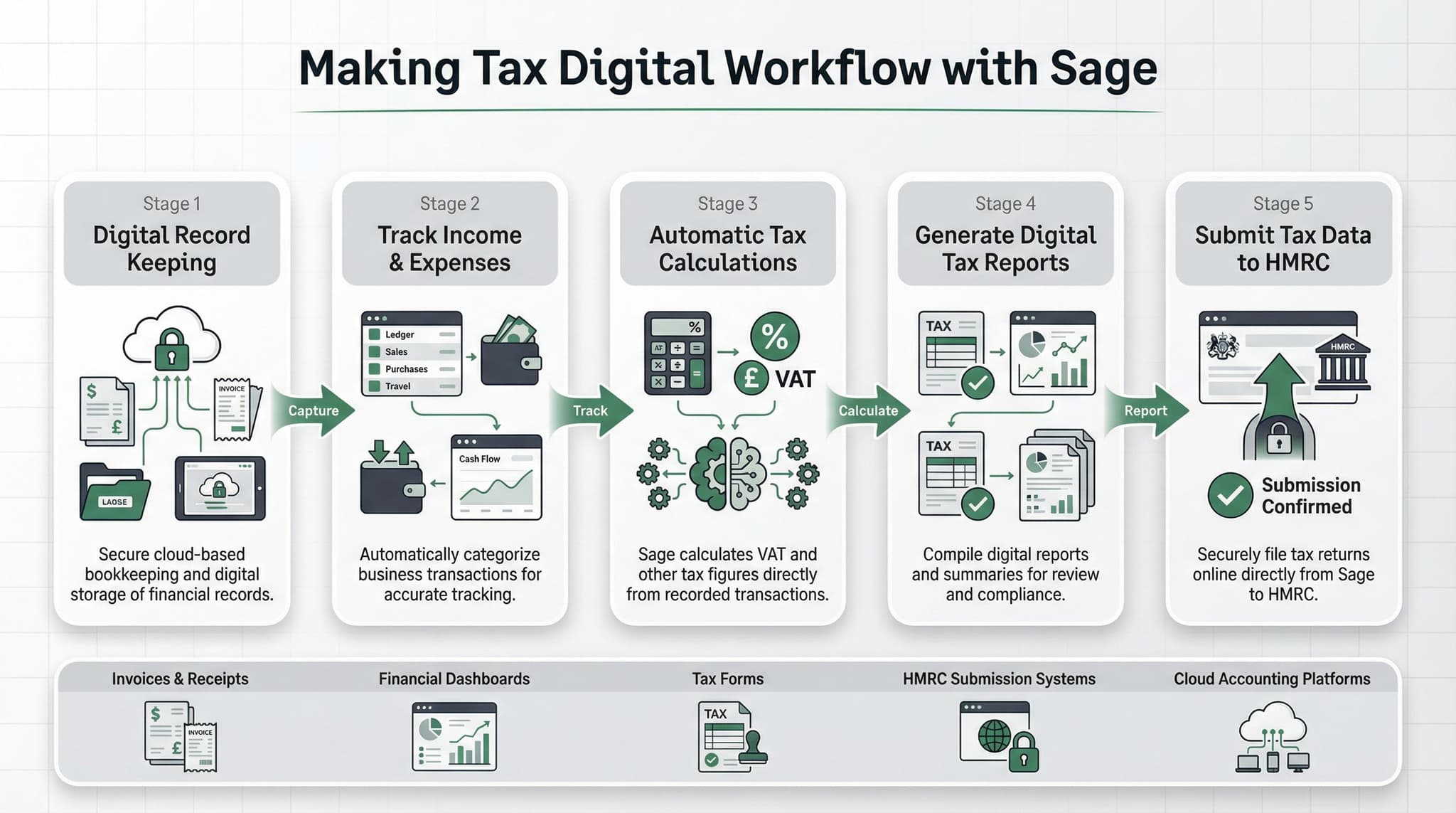
With MTD for Income Tax kicking in from April 2026, Sage has moved fast — they've built a dedicated MTD Automation Agent right inside Sage Copilot that handles client categorisation, quarterly task scheduling, and early issue flagging for accountants managing multiple clients. No other major UK accounting platform has shipped anything close to that level of MTD-specific AI automation yet, which puts Sage in a genuinely strong position heading into the biggest compliance shift in years. If you're an accountant or bookkeeper trying to figure out how to manage quarterly digital reporting at scale without drowning in admin, Sage is the platform worth watching right now.
What Is Sage Copilot? How AI Is Changing Accounting for UK Businesses
There's been a lot of noise about AI in accounting over the past year or two. Every software company seems to be adding "AI-powered" to their marketing pages. Most of the time, that means a chatbot, a slightly smarter search bar, or some auto-categorisation that works about 70% of the time.
Sage Copilot is different. And I don't say that lightly.
I've been watching how the major UK accounting platforms are approaching AI, and Sage has quietly built something that goes beyond a feature checkbox. Sage Copilot is a genuinely embedded AI assistant that monitors your financial data, automates routine admin, flags problems before you see them, and — in some cases — actually takes action on your behalf. It's not perfect. No AI tool is. But it's a meaningful step forward in how UK businesses can run their finances.
This article explains what Sage Copilot actually is, what it does in practice, how it fits into the broader Sage ecosystem, and why it matters for UK businesses right now. No hype. No jargon. Just a straight explanation of what's there, what's coming, and whether it's worth paying attention to.
So what actually is Sage Copilot?
Sage Copilot is a generative AI-powered productivity assistant built directly into Sage's accounting products. It's not a separate app. It's not a third-party plugin. It lives inside the software you're already using — whether that's Sage Accounting, Sage 50, or Sage Intacct.
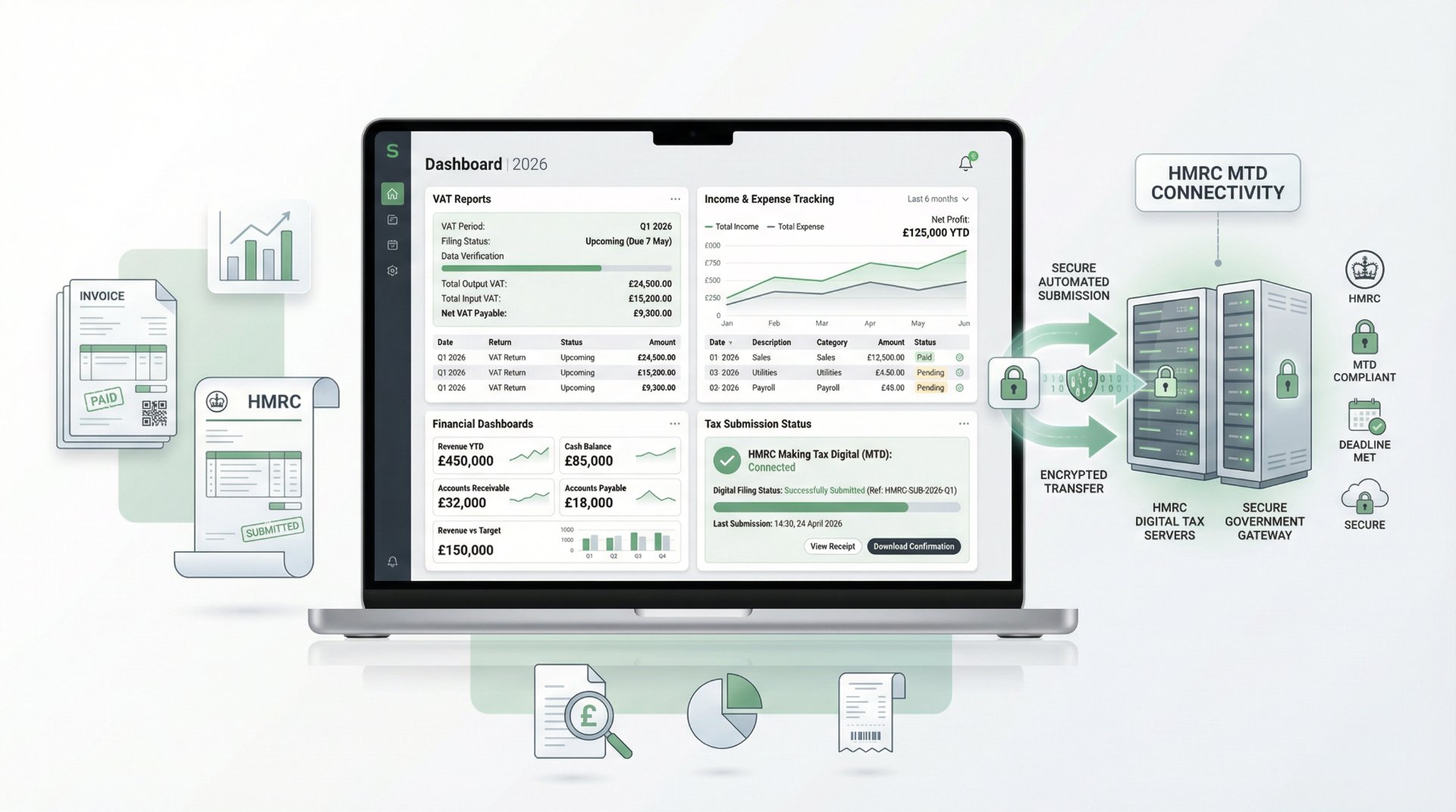
Sage describes it as an AI assistant that helps automate tasks, surface key insights, and simplify business management. But that's the polished version. Let me break down what it actually does in day-to-day terms.
At its core, Copilot does three things. First, it watches your data. It continuously monitors your financial records — transactions, invoices, payments, expenses, cash flow — and looks for patterns, anomalies, and trends. If something looks unusual, it tells you. If something needs attention, it flags it. You don't have to run a report or dig through spreadsheets to find problems. The problems come to you.
Second, it automates routine work. Things like following up on late invoices, prompting reconciliations, flagging overdue tasks, drafting emails, and capturing data from receipts. The kind of admin that eats two or three hours every week but never feels important enough to prioritise. Copilot handles that layer so you can focus on the work that actually needs a human brain.
Third, it answers questions. You can ask Copilot about your software, your data, and your accounting scenarios, and it gives you contextual, relevant answers. Not generic help articles. Actual guidance based on what's happening in your business right now.
What does it look like in practice?
Let me walk through some of the specific things Sage Copilot can do, because the abstract description only gets you so far.
Invoice chasing
Copilot automatically reviews customer compliance with payment terms, identifies overdue invoices, and follows up using your preferred tone and timing. Sage says payments were received 7 days faster with Copilot based on an initial study of 21 customers. That's real cash flow impact.
Receipt and invoice capture
Copilot extracts totals, tax amounts, dates, and supplier details from receipts and invoices with high accuracy. On Standard and Plus plans, you get 30 and 100 AI-approved captures respectively. It's not just OCR. It's contextual data extraction that understands what it's looking at.
Anomaly detection
Copilot continuously monitors for unusual patterns — abnormally large vendor invoices, sudden expense spikes, unusual revenue fluctuations, duplicate transactions, and other red flags. It alerts you in real time rather than waiting for month-end review.
Automated reporting
In Sage 50, you can create reports using natural language. Just tell Copilot what you want to see, and it builds the report. No navigating menus, no setting up filters manually, no exporting to Excel to reorganise columns. You describe it. It creates it.
The time savings are worth understanding
Sage ran a study with 570 small businesses and accountants to understand the time impact of Copilot's capabilities. The respondents saw demos of each feature and then estimated how much additional time they'd save per week. The results were pretty striking.
| Capability | Estimated time saved per week | Estimated time saved per month |
|---|---|---|
| Invoicing (creating emails, sending invoices, quotes, reminders) | 2.1 hours | ~9 hours / 1.1 working days |
| Reporting (automated report builds, scheduling, and sending) | 1.9 hours | ~8.2 hours / 1 working day |
| Payment chasing (identifying and following up on overdue invoices) | 2.1 hours | ~9 hours / 1.1 working days |
| Admin (purchase orders, invoice uploads, supplier payments, AP automation) | 6.1 hours | ~27.3 hours / 3.4 working days |
Now, I always take survey-based time estimates with a grain of salt. People tend to be optimistic about how much time tools will save them. But even if you cut those numbers in half, you're still looking at potentially saving one to two full working days per month. For a small business owner or a sole bookkeeper, that's significant. That's the difference between finishing at 5pm and finishing at 8pm on a Friday.
And the admin number — 6.1 hours per week — is particularly interesting. That's the dull, repetitive, low-value work that nobody wants to do but everyone has to do. If Copilot can genuinely take on even half of that burden, it changes the economics of running a small finance function.
How it works inside Sage Accounting
If you're using Sage Accounting — the cloud product aimed at UK small businesses — Copilot is included in your plan. One Copilot user is included from the Start plan, with additional Copilot users available on Standard and Plus.
Inside Sage Accounting, Copilot primarily focuses on the workflows that matter most for small businesses: invoicing, payment chasing, receipt capture, and basic insight generation. It sits inside your existing workflow rather than requiring you to open a separate tool or dashboard. You just work the way you normally would, and Copilot handles the parts it can automate or improve.
The invoice chasing feature is probably the most immediately impactful for small businesses. If you've ever spent an afternoon writing awkward "just following up on this invoice" emails, you know how tedious and uncomfortable that process is. Copilot does it for you — automatically identifying overdue invoices, drafting follow-up communications in your tone, and sending them on your behalf. You stay in control of the process, but you don't have to do the legwork.
For the receipt capture side, Copilot extracts the key financial data — totals, VAT, dates, supplier names — and feeds it into your books. It's not just scanning an image. It's understanding the financial context of what's on the receipt and placing it where it needs to go in your accounting records. It's the kind of thing that sounds small but adds up to a lot of saved time across a month.
How it works inside Sage 50
Sage 50 is the desktop product that a huge number of UK businesses still use. And Sage hasn't left those users behind. Copilot is available inside Sage 50 as well, launched directly from the menu bar.
One of the standout features in Sage 50 is the "Report with Copilot" capability. You can create reports using natural language — just describe what you want in plain English, and Copilot generates it. That's a genuine workflow improvement for people who currently spend time navigating report builders, adjusting filters, and reformatting outputs. You tell Copilot what you need. It gives it to you.
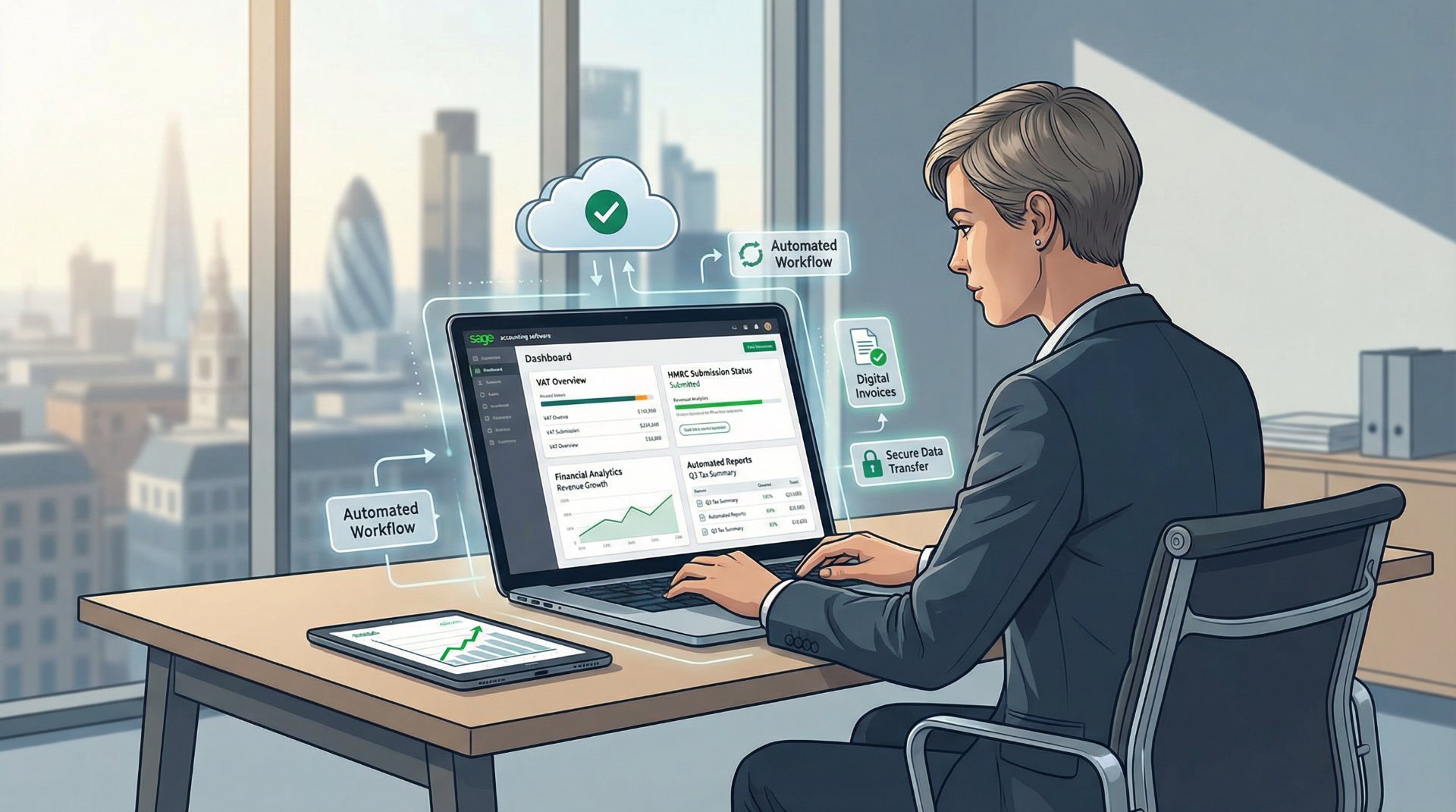
There's also an "Instant Report Analysis" feature that helps you understand what your reports are actually telling you. Instead of staring at a profit and loss statement and trying to work out what changed and why, Copilot can highlight the key movements and explain them in plain language. For business owners who aren't trained accountants, that kind of contextual interpretation is incredibly valuable.
How it works inside Sage Intacct
This is where things get really interesting, because Sage Intacct is the mid-market and enterprise product, and the AI capabilities are deeper.
Inside Sage Intacct, Copilot focuses heavily on the month-end close process. If you've ever worked in a finance team, you know that month-end close is one of the most stressful, time-consuming, and error-prone parts of the job. Copilot tracks close activities, monitors what's been completed, flags what's missing, prompts reconciliations, and provides a real-time dashboard covering AR, AP, GL, and cash accounts.
Sage describes Copilot as "the first gen-AI assistant focused on automating the month-end close process for finance teams." That's a big claim, but the functionality backs it up. It orchestrates the close by tracking and managing activities from record to report, providing proactive notifications to reduce chasing and delays, and continuously identifying potential errors throughout the month rather than discovering them after the close.
For CFOs and controllers, the real value is shifting from reactive problem-solving to proactive monitoring. Instead of finding errors during close week, you catch them during the normal course of the month. Instead of chasing people for reconciliations, the system prompts them automatically. The close gets shorter, cleaner, and less stressful.
The AI Agents — this is where Sage is heading
Sage Copilot is the assistant. But sitting behind it — and increasingly working alongside it — is a growing network of AI Agents. These are purpose-built autonomous tools that handle specific operational tasks. And they represent where Sage's AI strategy is really going.
As of early 2026, the network includes:
Close Agent
Manages and automates month-end close workflows. Tracks tasks, monitors progress, flags bottlenecks, and provides close analytics showing days to close, task completion rates, and areas of delay.
Accounts Payable Agent
Optimises vendor payment workflows. Handles automated bill entry, purchase order matching, classification, and payment scheduling. Reduces manual AP processing and improves accuracy.
Time Agent
Manages time tracking and entry workflows. Useful for project-based businesses and professional services firms where time is directly linked to billing and revenue recognition.
Assurance Agent
Supports audit readiness and internal control workflows. Monitors data integrity and helps maintain consistent, accurate records suitable for external review.
Finance Intelligence Agent
This is the newest and potentially most powerful. It lets finance teams ask natural-language questions and receive instant, actionable answers that combine data, analysis, and recommendations. It routes questions to the appropriate data sources and AI agents, coordinates responses, and composes a final answer. Available to early adopters in the US, UK, and Canada.
MTD Automation Agent
Specifically designed for UK accountants managing Making Tax Digital compliance across client bases. Handles client categorisation, quarterly task scheduling, document management, and early issue identification. Launched inside Sage Copilot in late 2025.
Sage CEO Steve Hare described the vision clearly: "It's incredibly important that we give finance teams technology that doesn't just respond to requests, but works alongside them proactively. With our AI Agents, we are helping teams save time, surface insights faster, and perform at their best. This is authentic, finance-first AI that empowers high-performing teams and equips them with transparent, accurate, and audit-ready insights."
What I find interesting about this approach is that Sage isn't trying to build one giant AI that does everything. They're building a network of specialists. Each agent has a specific job. They work together through Copilot as the coordination layer. And they're designed for finance workflows specifically — not repurposed general AI with a finance skin.
Dan Miller, Sage's EVP for Financials and ERP, put it well: "Whether it's optimising vendor payments, guiding teams through the close, or providing financial insight, these Agents save valuable time while helping finance professionals deliver consistent, high performance."
The partner platform — letting others build on Sage AI
Here's something that most people have missed, and I think it's strategically significant.
Sage has also launched AI Developer Solutions — a platform that lets partners build and deploy certified AI agents and workflow automation on Sage's infrastructure. That means third-party developers can create their own specialised AI agents that plug directly into the Sage Copilot experience.
Aaron Harris, Sage's CTO, described it as "the next step in Sage's platform journey. We are giving our partners the ability to build with Sage intelligence at their core. Together, we can accelerate innovation for millions of small and mid-sized businesses, bringing AI Agents out of the lab and into the real workflows where they'll make the biggest impact."
This is a platform play. Sage isn't just building AI tools. They're building an AI ecosystem. And that has the potential to make the Sage Copilot experience much richer over time as partners contribute specialised agents for industry-specific workflows, niche compliance requirements, and operational use cases that Sage alone wouldn't prioritise.
What about the competition?
It's fair to ask how Sage Copilot compares to what Xero and QuickBooks are doing with AI.
Xero has been investing in automation — auto-reconciliation, Hubdoc for document capture, and various workflow improvements. Xero's approach is solid and incremental. But as of early 2026, Xero hasn't launched a proactive AI assistant at the same level as Sage Copilot. Its AI strategy feels more about improving existing features than introducing a new layer of intelligence.
QuickBooks has Intuit Assist, which handles categorisation suggestions, reconciliation assistance, and some conversational features. It's a good tool. But Intuit Assist currently feels more like a smart helper that responds when asked, whereas Sage Copilot is designed to be proactive — watching your data and telling you what matters without waiting for a prompt.
None of these platforms are standing still. AI is moving fast, and what's true today might look different in six months. But right now, in March 2026, Sage has the most developed and most proactive AI assistant in the UK accounting software market. That's not a marketing opinion. It's based on what's actually shipped and available to users.
| Feature | Sage Copilot | Xero | QuickBooks (Intuit Assist) |
|---|---|---|---|
| Proactive anomaly detection | ✅ | Limited | Limited |
| Auto invoice chasing | ✅ | Via add-ons | Basic reminders |
| AI receipt/invoice capture | ✅ | Via Hubdoc | ✅ |
| Natural language reporting | ✅ (Sage 50 / Intacct) | Not yet | Limited |
| Month-end close automation | ✅ (Intacct) | Not available | Not available |
| AI Agent network | ✅ (6+ agents) | Not yet | Early stage |
| MTD-specific AI automation | ✅ | Not yet | Not yet |
| Real-time variance tracking | ✅ (Intacct) | Via reports | Via reports |
| Partner AI agent marketplace | ✅ (launching) | Not yet | Not yet |
Is it actually useful, or is it just marketing?
This is the question that matters most, and I want to be honest about it.
Some of what Sage Copilot does right now is genuinely useful. The invoice chasing is practical and saves real time. The receipt capture works well. The anomaly detection catches things that humans miss. The reporting features in Sage 50 are a real workflow improvement. And for Sage Intacct users, the close automation is a game-changer.
Some of it is still evolving. The Finance Intelligence Agent is in early adopter mode. Some capabilities on Sage's Copilot overview page are described as illustrative of the vision rather than currently available in every product and region. Sage themselves say that "future features should not be relied upon for purchase decisions." I appreciate that honesty.
The fair assessment is this: Sage Copilot is the most ambitious and most finance-specific AI assistant in the UK accounting market right now. It's not finished. No AI product is. But what's already shipped is useful, and the roadmap is credible. If you're a Sage user, you're getting genuine value from Copilot today and you're likely to get more over time. If you're evaluating accounting platforms and AI matters to you, Sage deserves to be at the top of your list.
Why this matters for UK businesses specifically
The UK has some specific pressures that make AI in accounting especially relevant right now.
MTD for Income Tax starts in April 2026. That means quarterly digital reporting for hundreds of thousands of sole traders and landlords. Sage has built an MTD-specific AI automation tool inside Copilot that helps accountants manage this across their client base — categorising clients, scheduling tasks, managing documents, and flagging issues early. No other UK platform has shipped anything equivalent yet.
Small businesses in the UK are also dealing with rising costs, cash flow pressure, and increasingly complex compliance requirements. In that environment, anything that reduces admin time, improves cash collection, catches errors earlier, and gives owners better visibility over their finances is worth taking seriously.
And there's a broader point here. For years, AI in business software was something that happened to big companies with big budgets. What Sage is doing with Copilot is making that same kind of intelligence available to a sole trader on an £18/month accounting plan. That democratisation of AI — making it practical and affordable for small businesses — is genuinely important.
What's coming next
Based on what Sage has announced and what's currently in early adopter programmes, here's what's likely coming to Copilot over the rest of 2026:
- Close Analytics — detailed breakdown of days to close, task bottlenecks, and completion patterns to help finance teams shorten their close cycle over time
- Finance Intelligence Agent general availability — broader rollout of the natural language Q&A capability across UK, US, and Canada
- Deeper AP automation — more intelligent bill processing, PO matching, and supplier payment optimisation
- Partner-built AI agents — third-party specialists plugging into the Copilot experience for industry-specific or workflow-specific use cases
- Cash Intelligence expansion — AI-driven short-term cash position management with payment prioritisation and shortfall detection
- Expanded MTD automation — deeper quarterly update management as MTD for Income Tax goes live and the second wave approaches in April 2027
The trajectory is clear. Sage is building toward a future where Copilot doesn't just assist with accounting tasks — it orchestrates them. The AI watches the data, the agents handle the workflows, and the human makes the decisions. That's the right model. It keeps humans in control while eliminating the drudgery.
Should you care?
If you're a UK business owner using Sage, you should absolutely be exploring Copilot. It's included in your plan. It's already useful. And it's getting better every quarter. Even if you just use the invoice chasing and receipt capture features, you'll probably save a few hours a month.
If you're an accountant or bookkeeper, the MTD automation tools and the broader practice management capabilities are worth serious attention. Managing MTD across dozens of clients manually is not sustainable. Copilot offers a structured, automated alternative.
If you're evaluating accounting software and you haven't looked at Sage's AI capabilities yet, you should. The gap between Sage Copilot and what the competition is currently offering is real. It may not last forever — Xero and QuickBooks are smart companies and they'll keep investing — but right now, Sage has a meaningful lead.
And if you're generally sceptical about AI in accounting — which is a perfectly reasonable position — I'd encourage you to try the specific features rather than dismissing the category. Sage Copilot isn't a gimmick. It's a finance-trained AI that understands accounting workflows, compliance requirements, and the daily realities of running a small business. It's not perfect, but it's useful. And "useful" is exactly what matters.
Final thought
The honest truth is that most AI in business software right now is underwhelming. A lot of it is basic automation repackaged with better marketing. A lot of it is chatbots that don't understand your data. A lot of it is "coming soon."
Sage Copilot is one of the exceptions. It's genuinely embedded. It's genuinely proactive. It's genuinely built for finance. And it's genuinely available — not on a roadmap, not in a demo, but inside the accounting software that millions of UK businesses already use.
That doesn't mean it's going to transform your business overnight. AI rarely works that way. But it does mean that if you lean into it — if you let Copilot chase your invoices, capture your receipts, flag your anomalies, and surface your insights — you'll probably run your finances a little better, a little faster, and with a little less stress.
And honestly? For a small business owner juggling everything else, that's a pretty good deal.