Reducing Payroll Errors by 80%: How Automation Improved Compliance.
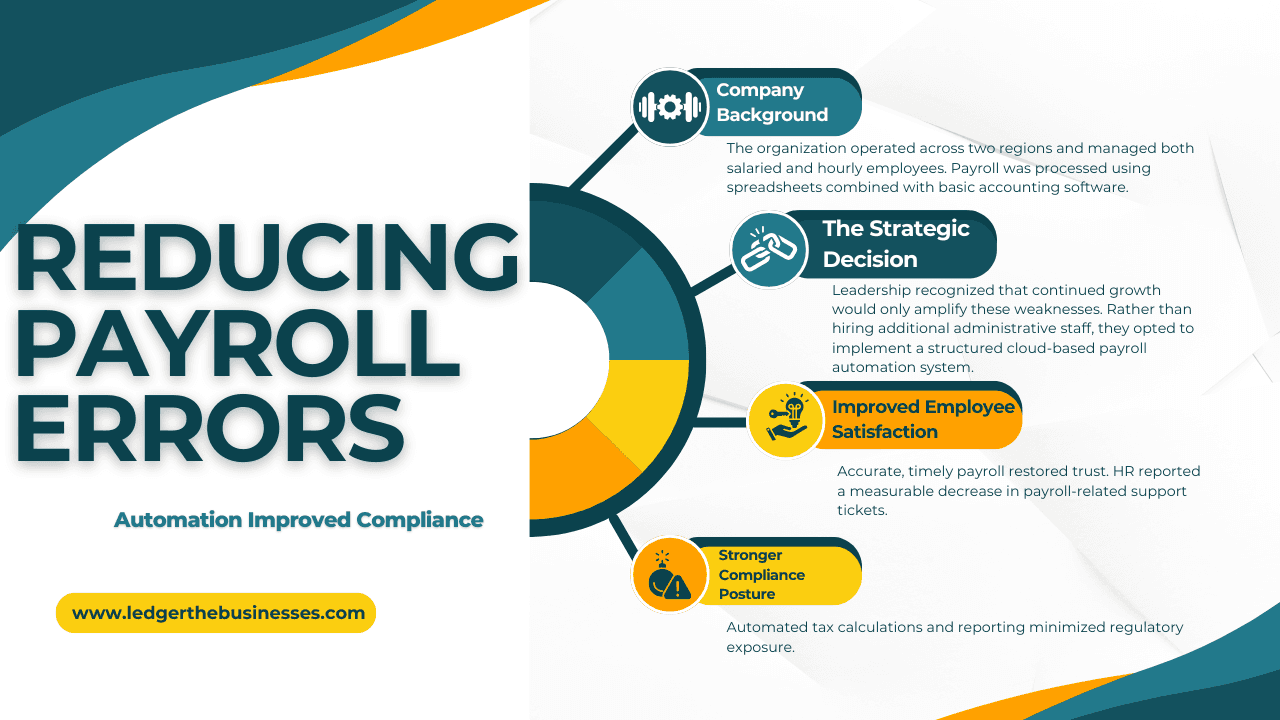
◆ Reducing Payroll Errors by 80%: How Automation Improved Compliance
A case study on how structured payroll software transformed accuracy, employee trust, and regulatory control.
Payroll is one of the most sensitive and high-risk functions within any growing organization. Even small inaccuracies — miscalculated deductions, delayed payments, incorrect tax codes — can create significant financial, legal, and reputational consequences.
This case study examines how a mid-sized professional services firm with 85 employees reduced payroll errors by 80% within six months by implementing structured payroll automation. The transformation not only improved compliance but also increased employee confidence and reduced administrative workload.
▸ Company Background
The organization operated across two regions and managed both salaried and hourly employees. Payroll was processed using spreadsheets combined with basic accounting software.
As headcount grew from 40 to 85 employees within two years, complexity increased significantly. Overtime tracking, regional tax variations, and benefits deductions created pressure on the finance team.
▸ The Problem
Before automation, payroll processing faced recurring challenges:
| Issue | Impact |
|---|---|
| Manual data entry | Frequent calculation errors |
| Inconsistent tax code updates | Compliance risk & penalties |
| Late payroll processing | Employee dissatisfaction |
| Fragmented time tracking | Incorrect overtime payments |
| No structured approval workflow | Lack of accountability |
Over a 12-month period, payroll discrepancies affected approximately 18% of pay cycles. Regulatory penalties were issued twice due to reporting delays.
▸ The Strategic Decision
Leadership recognized that continued growth would only amplify these weaknesses. Rather than hiring additional administrative staff, they opted to implement a structured cloud-based payroll automation system.
The goal was not just to reduce errors, but to create a scalable payroll infrastructure aligned with compliance requirements and financial controls.
▸ Implementation Process
◉ Phase 1: Data Cleanup
Employee records, tax codes, and benefits data were audited and standardized.
◉ Phase 2: System Integration
The payroll platform was integrated with time tracking tools and accounting software to ensure real-time data synchronization.
◉ Phase 3: Workflow Structuring
Approval hierarchies and automated validation checks were established to reduce unauthorized adjustments.
◉ Phase 4: Staff Training
HR and finance personnel received structured training to ensure smooth adoption.
▸ Measurable Results After Six Months
| Metric | Before Automation | After Automation |
|---|---|---|
| Payroll error rate | 18% of cycles affected | 3–4% minor adjustments |
| Processing time | 3–4 days per cycle | 1.5 days per cycle |
| Compliance penalties | 2 per year | 0 reported |
| Employee complaints | Frequent | Reduced significantly |
The organization achieved an estimated 80% reduction in payroll-related errors and eliminated compliance penalties within the first half-year.
▸ Broader Business Impact
◉ Improved Employee Satisfaction
Accurate, timely payroll restored trust. HR reported a measurable decrease in payroll-related support tickets.
◉ Stronger Compliance Posture
Automated tax calculations and reporting minimized regulatory exposure.
◉ Operational Efficiency
Finance teams redirected time from manual corrections to financial planning and analysis.
◉ Scalable Growth Infrastructure
The payroll system now supports future headcount expansion without proportional increases in administrative workload.
▸ Key Lessons Learned
• Payroll errors often stem from structural weaknesses rather than isolated mistakes.
• Automation reduces risk but must be supported by clean data and defined processes.
• Compliance improvement directly impacts financial stability.
• Investing in payroll infrastructure strengthens organizational trust.
▸ Conclusion
Payroll automation was not merely a technological upgrade for this organization — it was a strategic restructuring of a high-risk operational function.
By reducing errors by 80%, eliminating penalties, and shortening processing time, the company transformed payroll from a recurring liability into a reliable and scalable system.
For growing businesses, payroll accuracy is more than administrative efficiency. It is a foundation of compliance, credibility, and employee confidence.