The Difference Between Bookkeeping and Accounting (And Why Both Matter)
Bookkeeping and accounting are closely connected but serve different roles in business finance. Bookkeeping focuses on recording daily financial transactions accurately, while accounting analyzes that information to generate reports, insights, and strategic guidance. Together, they create a complete financial system that helps businesses maintain accurate records, understand their financial position, and make better operational decisions.
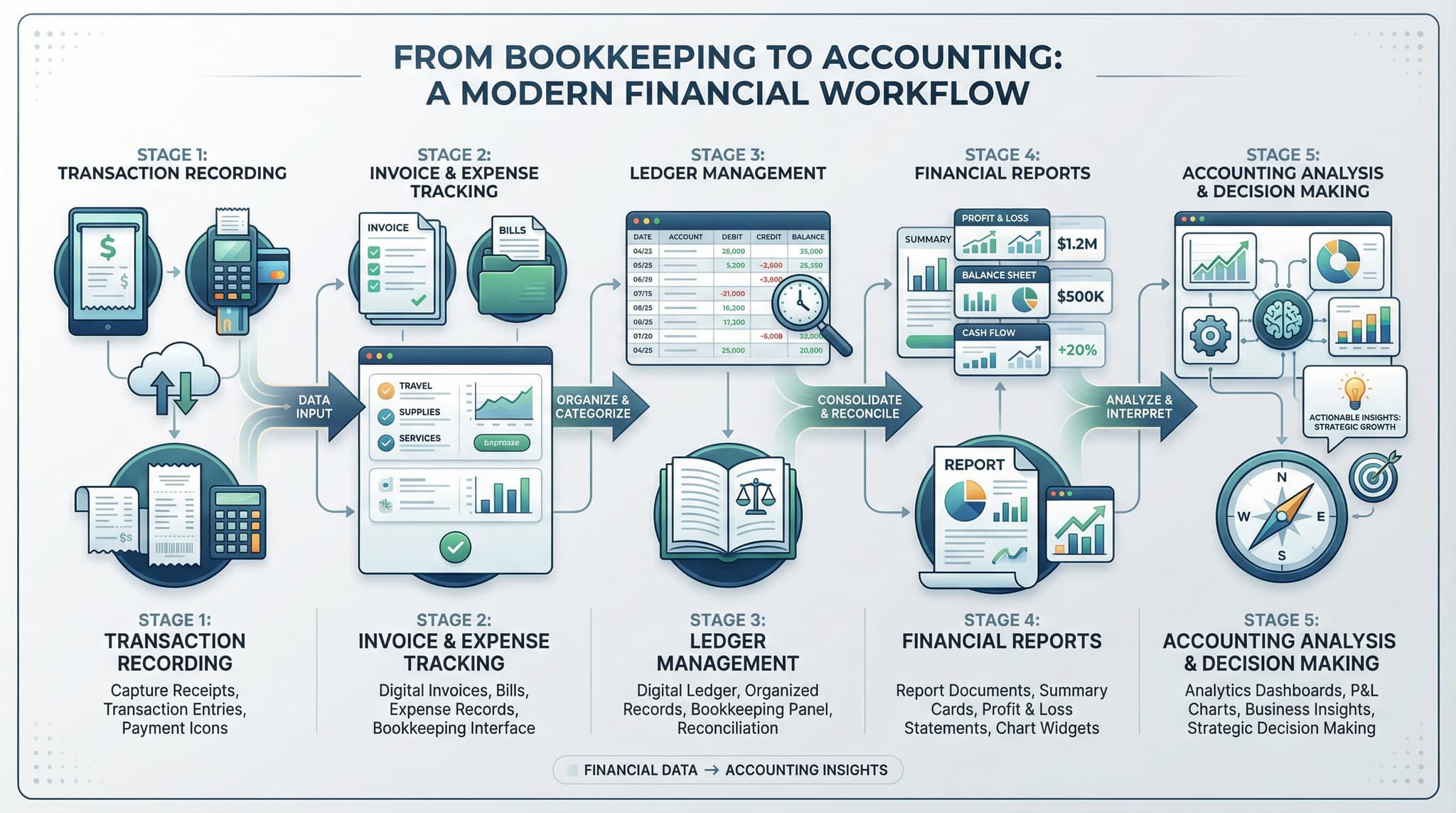
Many business owners use the terms bookkeeping and accounting interchangeably. While the two functions are closely related, they are not the same. Understanding the difference between bookkeeping and accounting is important because both play distinct roles in maintaining financial clarity, operational stability, and long‑term business decision‑making.
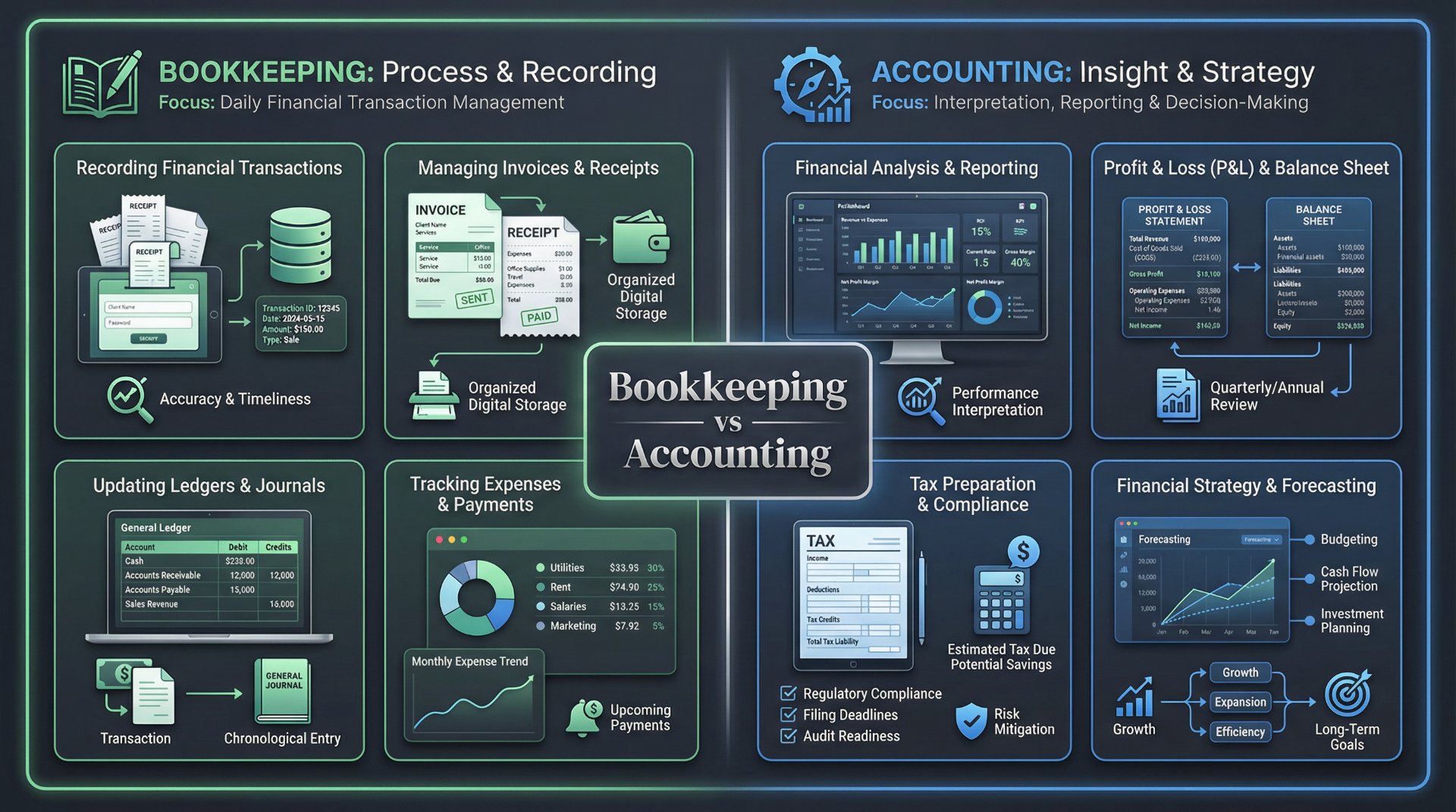
Bookkeeping focuses on recording financial transactions accurately and consistently. Accounting builds on that information to interpret financial data, create reports, and guide strategic decisions. Without reliable bookkeeping, accounting becomes difficult. Without accounting, bookkeeping data remains underutilized. Together, they form the financial backbone of a well‑managed business.
Understanding Bookkeeping
Bookkeeping is the process of systematically recording every financial transaction within a business. This includes sales, purchases, payments, receipts, payroll activity, and other financial movements. The goal of bookkeeping is accuracy and organization. It ensures that all financial activity is documented properly so that businesses always know where their money is coming from and where it is going.
Historically, bookkeeping was done manually using ledgers or spreadsheets. While this approach can work for very small businesses, it quickly becomes difficult to maintain as transaction volumes increase. Modern businesses increasingly rely on cloud accounting platforms to streamline bookkeeping tasks such as transaction recording, bank reconciliation, and invoice tracking.
With digital tools, bookkeeping becomes faster and more reliable. Many platforms allow businesses to automatically import bank transactions, categorize expenses, generate invoices, and maintain organized financial records. Solutions such as Sage Accounting, for example, allow businesses to keep their bookkeeping up to date while reducing the time spent on repetitive administrative work.
Typical Bookkeeping Responsibilities
- Recording financial transactions
- Managing invoices and receipts
- Tracking payments and expenses
- Reconciling bank statements
- Maintaining organized financial records
These activities may appear routine, but they are critical. Accurate records ensure that financial data remains reliable and ready for further analysis.
Understanding Accounting
Accounting goes beyond simply recording transactions. It involves analyzing financial information, interpreting patterns, preparing reports, and helping businesses understand their financial position. Accountants use the structured records produced through bookkeeping to generate insights that guide strategic decisions.
Where bookkeeping answers the question "what happened," accounting focuses on "what it means." This includes evaluating profitability, preparing financial statements, managing tax obligations, and helping business owners understand the financial health of their company.
Modern accounting increasingly relies on integrated financial platforms. When bookkeeping and accounting exist within the same digital system, financial reporting becomes far more efficient. Cloud platforms like Sage allow accountants to access up‑to‑date financial records instantly, which helps them generate accurate reports and provide better advisory support.
Typical Accounting Responsibilities
- Preparing financial statements
- Analyzing financial performance
- Managing tax and compliance obligations
- Advising on budgeting and financial planning
- Providing strategic financial insights
Accounting transforms raw financial data into information that business leaders can use to make informed decisions.
Why Businesses Need Both
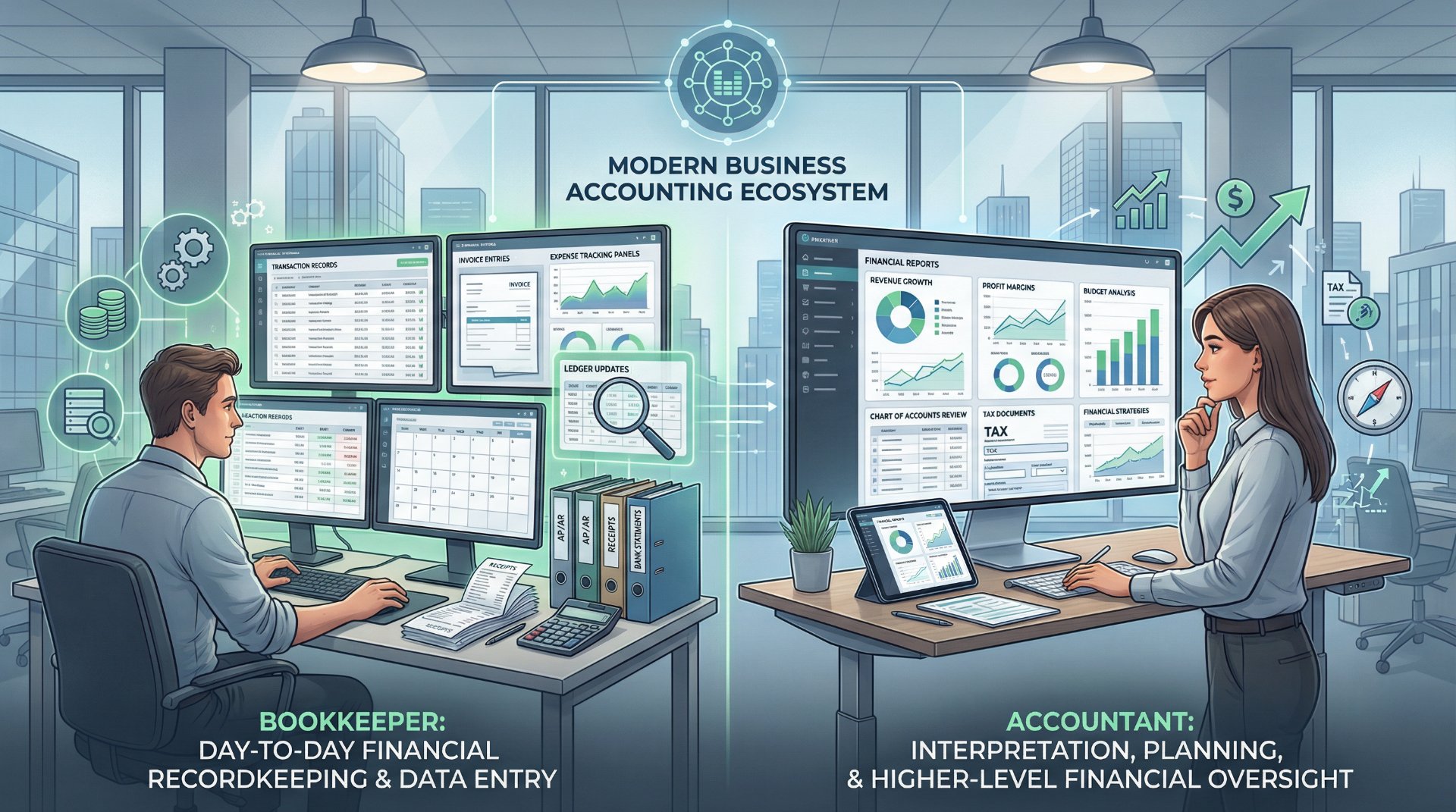
Bookkeeping and accounting are often described as two parts of the same financial system. Bookkeeping provides the structured data, while accounting interprets that data. If bookkeeping records are incomplete or inaccurate, accounting analysis becomes unreliable. Similarly, if businesses only focus on recording transactions but never analyze them, valuable insights are lost.
For growing businesses, the relationship between these two functions becomes even more important. As transaction volumes increase, financial complexity grows as well. Without reliable systems, it becomes difficult to track performance, manage expenses, or plan for future growth.
This is one reason many companies adopt cloud accounting platforms that integrate both functions into a single system. Platforms such as Sage help businesses maintain accurate bookkeeping while also supporting accounting processes like financial reporting, VAT tracking, and performance analysis.
The Role of Technology in Modern Financial Management
Technology has significantly changed how bookkeeping and accounting are performed. Manual spreadsheets and disconnected systems can still work for very small operations, but they often create inefficiencies and increase the risk of errors. Modern businesses benefit from integrated systems that automate repetitive tasks and maintain accurate records automatically.
Cloud accounting platforms help streamline bookkeeping tasks such as invoice generation, bank reconciliation, and expense categorization. At the same time, these systems support accounting functions by generating financial reports, tracking tax obligations, and providing dashboards that summarize financial performance.
Tools like Sage Accounting illustrate this shift toward integrated financial management. By combining bookkeeping and accounting workflows within one platform, businesses gain real‑time visibility into their financial activity and reduce the administrative burden associated with traditional accounting processes.
How Financial Visibility Improves Decision‑Making
One of the most important benefits of combining bookkeeping and accounting effectively is improved financial visibility. When transactions are recorded accurately and analyzed regularly, businesses gain a clearer understanding of their financial position.
This visibility helps business owners answer critical questions:
- Are revenues growing consistently?
- Which expenses are increasing?
- Is cash flow stable?
- Are financial operations efficient?
When financial systems are organized and accessible, leaders can make decisions with greater confidence. Instead of relying on outdated reports or scattered spreadsheets, they can review accurate financial information whenever needed.
Why Small Businesses Often Confuse the Two
In many small businesses, bookkeeping and accounting responsibilities are handled by the same person. This makes the distinction between the two roles less obvious. A founder may record transactions, create invoices, track expenses, and review financial performance all within the same system.
However, even when one person manages both functions, the activities themselves remain different. Recording transactions requires precision and consistency, while financial analysis requires interpretation and strategic thinking. Understanding this difference helps businesses structure their financial processes more effectively.
Building a Strong Financial Foundation
A well‑structured financial system begins with reliable bookkeeping and expands into effective accounting practices. When both functions operate together within a consistent workflow, businesses gain stronger financial control. They can monitor performance more clearly, manage compliance obligations more easily, and plan future growth with greater confidence.
Digital platforms increasingly support this integrated approach. By connecting transaction recording, invoicing, reporting, and financial analysis in one environment, cloud accounting systems simplify the relationship between bookkeeping and accounting. Businesses spend less time managing spreadsheets and more time understanding their financial performance.
Final Thoughts
Bookkeeping and accounting serve different but complementary roles in business finance. Bookkeeping ensures that financial transactions are recorded accurately and consistently, while accounting interprets that information to guide strategic decisions. When both functions operate effectively, businesses gain the clarity needed to manage operations, maintain compliance, and support long‑term growth.
As financial operations become increasingly digital, many companies rely on cloud accounting systems to integrate bookkeeping and accounting processes into one structured platform. Solutions like Sage Accounting help businesses maintain accurate financial records while also providing the insights required to understand performance and plan for the future.
Ultimately, successful financial management depends on both accurate records and meaningful interpretation. Bookkeeping provides the foundation, accounting provides the insight, and together they support better decision‑making across the entire business.