Why Cloud Accounting Is Becoming Essential for Modern Businesses
Cloud accounting is transforming how modern businesses manage their financial operations by providing real-time access to financial data, improving efficiency, and reducing reliance on manual processes. By centralizing accounting, invoicing, payroll, and reporting into a connected system, businesses gain better visibility into their financial health and can make faster, more informed decisions. As companies grow and financial complexity increases, cloud accounting platforms have become essential for maintaining accuracy, compliance, and scalable financial management.
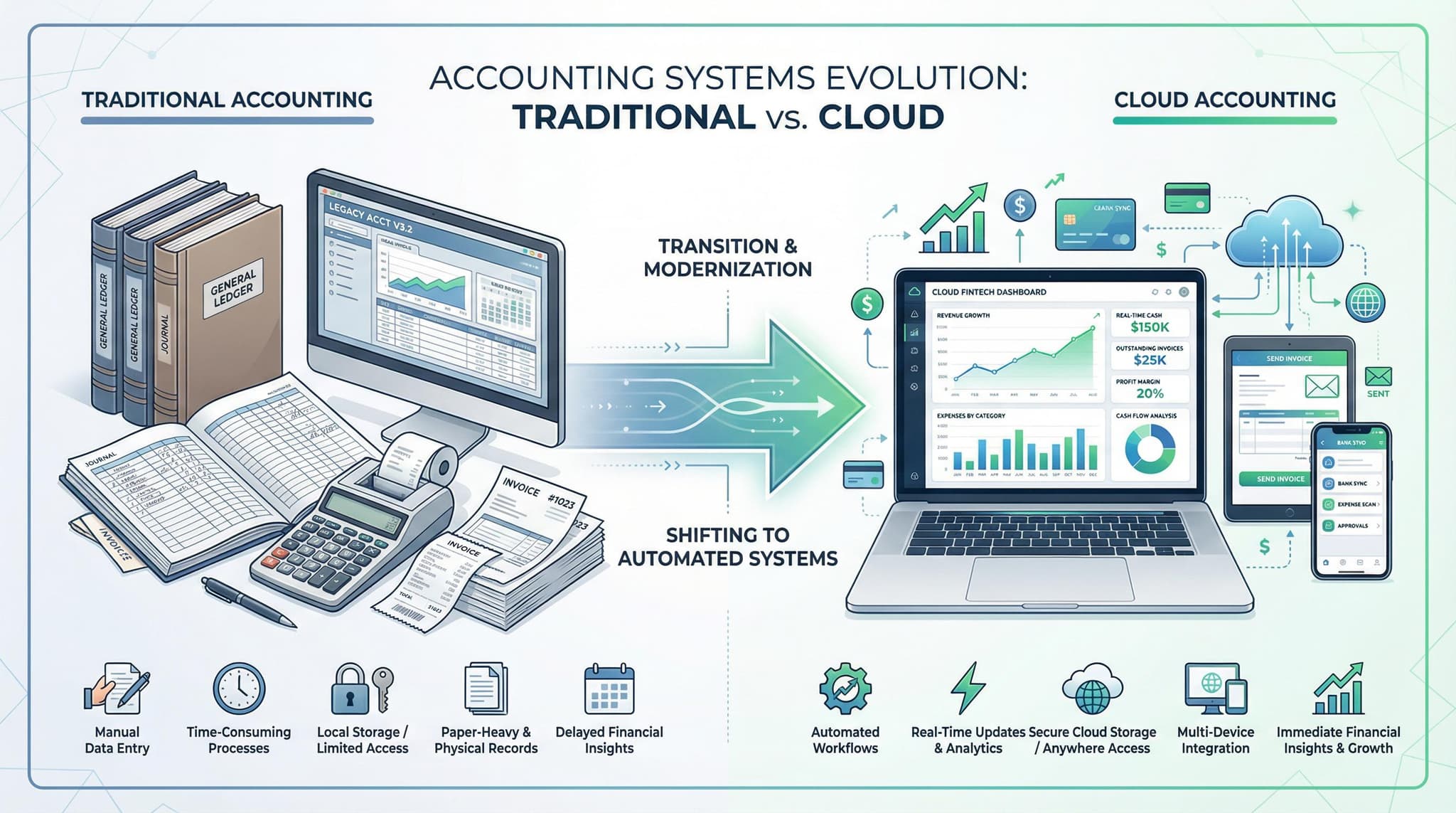
From real-time visibility to smoother invoicing, payroll, reporting, and compliance, cloud accounting is no longer just a software upgrade. For many businesses, it is becoming the foundation of more efficient financial operations.
For a long time, accounting was treated as something businesses handled in the background. It was often seen as a necessary administrative function rather than a strategic part of how a company operates. Records were stored in spreadsheets, invoices were created manually, reports were produced at the end of the month, and finance data was usually scattered across email threads, desktop folders, and disconnected tools. That approach may have been manageable for smaller businesses in the past, but it is becoming increasingly difficult to sustain in a fast-moving business environment.
Today, businesses are expected to move quickly, make better decisions, stay compliant, maintain healthy cash flow, and operate with greater financial accuracy. This is exactly why cloud accounting is becoming essential for modern businesses. It gives teams access to live financial information, improves day-to-day efficiency, reduces manual work, and helps business owners build stronger systems around reporting, invoicing, payroll, and tax processes.
Cloud accounting is not just about doing the same accounting tasks online. It represents a shift in how financial operations are managed. Instead of waiting until the end of the week or month to understand where the business stands, companies can work from current, connected, and accessible financial data. That difference matters more than ever.
The shift from traditional accounting to connected financial systems
Traditional accounting systems often rely on local software, fragmented spreadsheets, and processes that depend heavily on manual data entry. Even when the numbers are technically correct, the workflow around them is often slow. Data has to be updated, shared, checked, exported, and re-entered. That creates friction across the business. The finance team loses time, management loses visibility, and the risk of mistakes quietly increases.
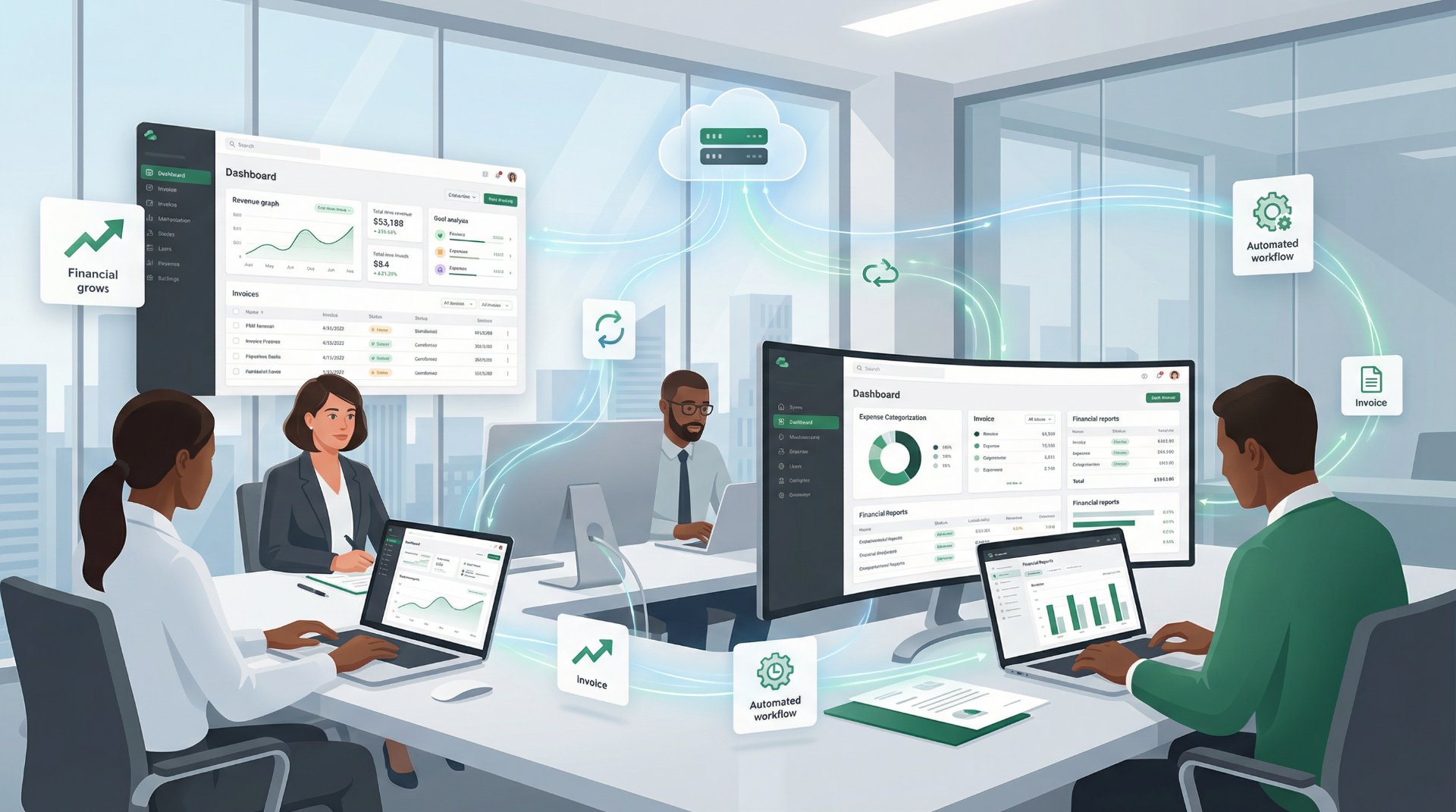
Cloud accounting changes that model by moving accounting functions into a centralized, internet-based system. Instead of being tied to one device or one office, financial information can be accessed securely from anywhere by authorized users. Transactions, invoices, reconciliations, reporting data, and compliance tasks can all live inside a unified platform. This improves coordination between departments and makes the finance function more responsive.
More importantly, cloud accounting reflects the realities of how modern businesses actually work. Teams are more distributed. Decision-making is faster. Business owners want visibility without constantly requesting spreadsheets. Finance needs to support operations, not slow them down. A cloud-based approach fits naturally into that environment.
Real-time visibility is now a competitive advantage
One of the biggest reasons cloud accounting is becoming essential is that it provides real-time financial visibility. In many businesses, decisions are still being made using outdated numbers. Leaders look at reports that were accurate last week or last month, but no longer reflect the current state of the business. That delay can affect cash flow planning, hiring decisions, supplier management, and overall confidence.
With cloud accounting, financial data is updated continuously as transactions are recorded, invoices are sent, payments are received, and bank feeds are synchronized. That gives business owners and finance teams a much clearer picture of what is happening right now, not just what happened previously. It becomes easier to understand revenue trends, outstanding invoices, spending patterns, and cash position without waiting for the next reporting cycle.
For growing businesses, this level of visibility is not just convenient. It can directly shape business performance. A company that can see payment delays earlier can take action faster. A team that understands its expense trends in real time can manage budgets more responsibly. A founder who can check the financial state of the business without digging through multiple files is in a stronger position to make timely decisions.
Manual processes are slowing businesses down
Another major reason cloud accounting is rising in importance is the cost of manual work. Many businesses still spend too much time on repetitive finance tasks: entering figures into spreadsheets, chasing receipts, copying invoice details, reconciling accounts by hand, updating payroll records separately, or compiling month-end reports from multiple sources. Each of these tasks may seem small on its own, but together they create a heavy operational burden.
Manual workflows also create inconsistency. Two people may record the same thing differently. A formula in a spreadsheet may be changed accidentally. An invoice may be sent late because the process depends on someone remembering to do it. A payroll detail may be missed because information was stored in the wrong place. These are not unusual problems. They are common symptoms of finance systems that have not evolved with the business.
Cloud accounting platforms reduce this friction by automating core tasks and standardizing processes. Invoice creation, payment reminders, recurring billing, bank reconciliation, expense categorization, and report generation can often be streamlined substantially. That does not remove the need for financial oversight, but it does reduce low-value administrative work. Teams can spend less time maintaining the process and more time improving it.
Better collaboration across the business
In traditional setups, accounting information is often locked away with one person or one department. If a founder needs a report, they ask finance. If operations need a payment update, they wait for an email. If an external accountant needs access, files are exported and sent back and forth. This slows communication and makes collaboration more fragile than it needs to be.
Cloud accounting improves collaboration because the system is shared and accessible to the right people at the right level. Business owners can view dashboards. internal teams can check invoice status. accountants or bookkeepers can log in directly without depending on old attachments or version confusion. Everyone works from the same source of truth.
This is especially valuable for businesses with remote teams, outsourced finance support, or multi-location operations. Financial management no longer depends on one office desktop or one person holding the latest spreadsheet. That accessibility creates continuity and makes it easier to keep finance aligned with the rest of the business.
Cash flow management becomes more practical
Cash flow remains one of the most important concerns for small and medium-sized businesses. Many companies do not fail because they lack customers. They struggle because they lack visibility into when money is coming in, what is going out, and where pressure is building. Poor invoicing habits, delayed payments, unclear reporting, and disconnected finance systems can make this worse.
Cloud accounting helps make cash flow management more practical and less reactive. When invoices are generated faster, tracked more clearly, and linked to payment status, businesses can identify overdue accounts sooner. When expenses and bank activity are visible in one place, leaders can understand short-term financial pressure more accurately. When dashboards show current financial indicators, planning becomes more grounded in reality.
This does not mean cloud accounting solves every cash flow problem automatically. But it gives businesses the infrastructure needed to manage cash flow more intelligently. That difference is critical. Good financial systems do not guarantee strong decisions, but weak systems almost always make good decisions harder.
Compliance is becoming more digital
Another reason cloud accounting is becoming essential is the wider shift toward digital compliance. Tax authorities, regulators, and reporting frameworks increasingly expect businesses to maintain cleaner records and use more structured digital processes. This is particularly important for companies operating in environments where VAT reporting, payroll compliance, and digital tax submissions are becoming more standardized.
When finance records are incomplete, inconsistent, or spread across separate tools, compliance becomes harder. The team spends more time preparing information, checking figures, and correcting issues. That increases stress and creates more room for costly mistakes. Cloud accounting systems help reduce that risk by keeping records organized, accessible, and easier to review.
For many businesses, compliance used to be treated as an occasional event. Now it needs to be built into regular operations. Cloud accounting supports that shift by making the accounting function more structured, traceable, and ready for ongoing reporting requirements.
Scalability matters more than ever
A system that works for a very small business may break down quickly as the business grows. More customers mean more invoices. More staff mean more payroll complexity. More transactions mean more reconciliation work. More reporting needs mean more pressure on the finance team. If the underlying systems remain manual, the strain multiplies fast.
Cloud accounting gives businesses a stronger foundation for scale. It helps standardize the finance function before complexity becomes unmanageable. Processes can be built with growth in mind rather than patched together after problems appear. This is one of the clearest reasons modern businesses are moving in this direction. They are not only solving today’s finance problems. They are preparing for future operational demands.
Scalability is not only about size. It is about resilience. A business with stronger financial systems can handle growth, staffing changes, new reporting requirements, and operational complexity with more confidence. That matters whether a company is expanding quickly or simply trying to operate more professionally.
Decision-making improves when the numbers are accessible
Business decisions often depend on financial clarity, but many leaders do not get that clarity in a usable format. Reports may exist, but they arrive too late. Data may be available, but it is difficult to interpret. Important figures may be technically recorded, but not organized in a way that supports strategic thinking.
Cloud accounting helps close that gap by making core financial data easier to access and review. Dashboards, categorized transactions, current balances, invoice tracking, and reporting tools make it easier to move from raw data to useful insight. Leaders can understand what is changing, where pressure is building, and what areas need attention.
This matters across all levels of the business. Founders can make better decisions about investment and hiring. Managers can monitor department spending more effectively. Finance teams can spend more time analyzing trends instead of gathering basic information. Better decisions do not come from more data alone. They come from organized, timely, and actionable data. That is what cloud accounting supports.
Customer and supplier relationships benefit too
Accounting systems are often discussed as internal tools, but they also affect external relationships. Customers notice when invoicing is slow, unclear, or inconsistent. Suppliers notice when payment processes are disorganized. Delays and administrative confusion can weaken trust, even when the underlying business is sound.
Cloud accounting can improve these interactions by creating more reliable financial workflows. Invoices can be issued more promptly. Payment records are easier to trace. Account histories are easier to review. Queries can be resolved faster because the information is visible and current. This may sound operational, but it contributes directly to professionalism.
Modern businesses are increasingly judged on how smoothly they operate, not only on what they sell. Financial efficiency is part of that impression. Stronger accounting systems support stronger business relationships.
Why this matters for smaller businesses, not just larger ones
There is a misconception that cloud accounting is mainly useful for larger organizations with complex finance teams. In reality, smaller businesses often benefit the most. They usually have fewer resources, less time, and a greater need to avoid unnecessary admin. Manual inefficiencies that are inconvenient for a large business can be genuinely damaging for a small one.
For founders and lean teams, cloud accounting reduces dependence on scattered tools and creates a more stable financial operating system. It can make bookkeeping simpler, improve invoice management, support payroll administration, and reduce the stress of staying organized. Instead of building finance around workarounds, smaller businesses can build it around a system designed to support growth and clarity.
This is one reason adoption continues to rise. Cloud accounting is no longer seen as a premium extra. It is increasingly viewed as a practical and necessary part of running a modern business well.
The real value is not only software, but financial discipline
It is important to say that cloud accounting is not a magic fix. No platform can replace sound judgment, disciplined processes, or careful financial oversight. Businesses still need to maintain good habits. They still need to review reports, follow up on overdue invoices, monitor cash flow, and keep records accurate. However, the right system makes those habits easier to maintain consistently.
That is where the real value lies. Cloud accounting helps businesses operate with greater financial discipline. It creates structure. It improves visibility. It reduces friction. It supports accuracy. And over time, those advantages compound. Businesses become better informed, more responsive, and less exposed to the weaknesses that come from outdated financial processes.
In that sense, cloud accounting is not just about modernization. It is about building a more dependable financial foundation for the business.
Final thoughts
Cloud accounting is becoming essential because the demands placed on modern businesses have changed. Companies need clearer visibility, faster reporting, smoother collaboration, better invoicing workflows, more structured compliance, and systems that can grow with them. Manual finance processes and disconnected tools are increasingly unable to support those expectations.
For business owners, the question is no longer whether finance should be digital. The more useful question is whether current financial systems are giving the business enough clarity, efficiency, and control to operate confidently. In many cases, cloud accounting is the step that turns finance from a reactive burden into a stronger part of business infrastructure.
- - It improves real-time financial visibility.
- - It reduces manual admin and process friction.
- - It supports better cash flow management.
- - It strengthens compliance and reporting readiness.
- - It gives growing businesses a more scalable foundation.
As businesses continue to prioritize efficiency, insight, and resilience, cloud accounting will not simply remain relevant. It will continue becoming a standard part of how modern companies run.